How to Build an Emergency Fund in New Zealand
Published 26 May 2025 · Updated 11 May 2026 · Written by the ValueHub team · Reviewed by Steve Baron
How to Build an Emergency Fund in New Zealand
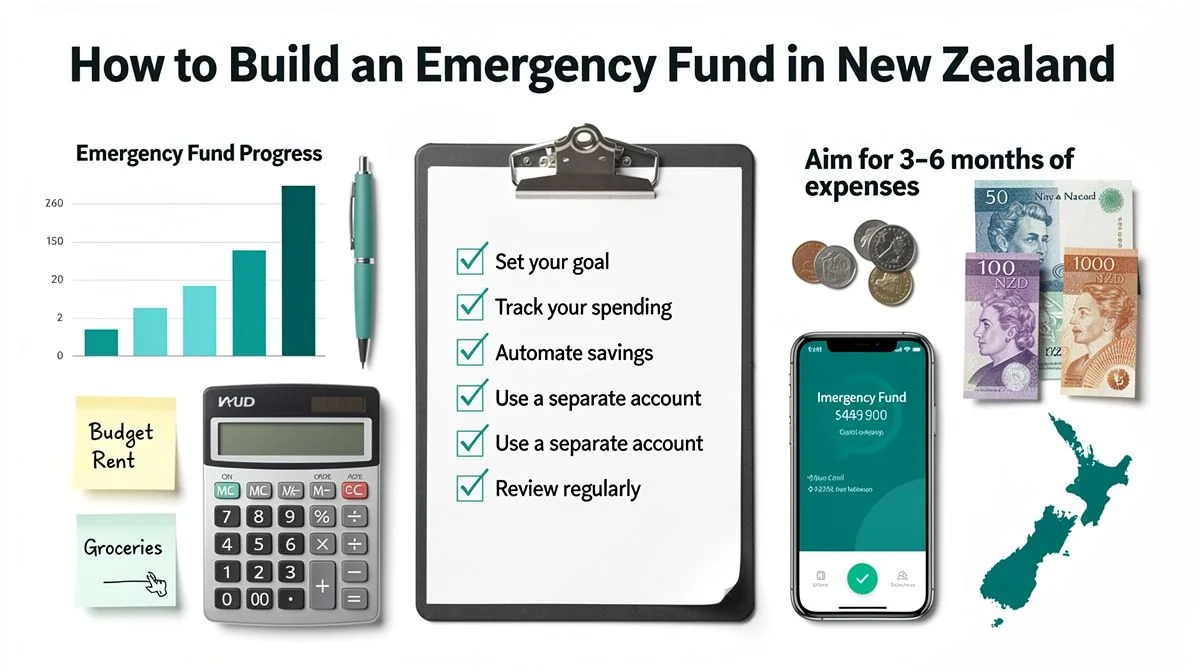
The most useful thing we can tell you about emergency funds is also the thing most guides skip: the target is measured in months of expenses, not a dollar figure someone else picked. Three to six months of essential costs is the standard rule of thumb. What that means in practice depends entirely on your life.
A single renter in Hamilton and a family with a mortgage in Auckland can follow the same rule and arrive at wildly different numbers. That's not a flaw in the rule. It's the point. The arithmetic is yours to run, and running it honestly is most of the work.
How We Researched This Guide
We started with the source material rather than other guides. The emergency fund rule of thumb — three to six months of essential expenses — is consistent across mainstream personal finance guidance, so we treated it as settled and focused on the parts that aren't: what counts as essential, who needs the longer end, and where the money should sit. For the free help section we went to the Ministry of Social Development's Building Financial Capability programme and FinCap, which delivers MoneyTalks. That's a genuine front door, not a sales channel.
One detail surprised us. MSD-funded financial mentoring services must be provided free — providers cannot accept fees, commissions, donations, gifts or koha for those services, and any payment offered has to be returned in full. That's a stronger guarantee than we expected. You can read how the programme is funded and delivered through the Building Financial Capability programme on msd.govt.nz. We also checked Inland Revenue's rules for side income, since a side hustle is one of the fastest ways to fund a buffer — and one of the easiest ways to create a tax problem.
ValueHub's Trusted Providers
We've researched the providers below — here are our picks for this category.
Harmoney is often the most competitive for borrowers who don’t qualify for bank‑tier rates. Their risk‑based pricing means excellent credit gets very sharp rates, while average credit still gets fair pricing. Approval is fast, fully online, and fees are transparent.
The Quick Summary (60-Second Version)
If you only read one part of this guide, read this.
- Your target is three to six months of essential expenses — rent or mortgage, groceries, power, internet, transport to work, insurance, and minimum debt repayments. Not income. Not salary.
- A $1,000 starter buffer is the widely used first milestone. Hit that before you worry about the bigger number.
- Keep it in an on-call or bonus saver savings account. Not shares, not KiwiSaver — the money has to be there immediately, without market risk.
- Automate the transfer for payday. Saving whatever is left at the end of the month reliably produces nothing.
- Minimum debt repayments belong in your essential expenses calculation. Extra repayments sit in the savings bucket.
- MoneyTalks is a free national helpline on 0800 345 123, funded through MSD and delivered by FinCap. Financial mentors are free and confidential.
Working Out Your Number
Add up your essential monthly expenses, then multiply by three and by six. That gives you a range, not a target. The range is the honest answer, because your circumstances decide where in it you land.
What counts as essential: rent or mortgage payments, groceries, power and internet, rates if you own, transport you need to get to work, insurance premiums, and minimum debt repayments. What doesn't: dining out, entertainment, non-essential clothing, holidays, and KiwiSaver contributions. That last one catches people out. KiwiSaver is savings, but it isn't accessible savings, so it can't do this job.
Who needs the longer end
Six months suits the self-employed and contractors, sole earners and single-income households, anyone with variable or seasonal income, households with dependants, people with high fixed costs, and anyone working in a sector where employment moves around. Three months is usually fine for a dual-income household with stable, in-demand jobs.
The review point
Inflation erodes what a fixed cash amount covers. A fund that was right two years ago may not cover three months of today's groceries. Review the target when your essential costs change — a rent increase, a new dependant, a rate rise — rather than setting it once and forgetting it.

Where to Keep It, and How to Protect It From Yourself
Accessibility is the whole design brief. The money has to be available immediately, without market risk, and separate enough that you don't spend it on a Tuesday.
| Account type | Access | Suits |
|---|---|---|
| On-call or bonus saver savings account | Same day or next day | Most people — the default choice |
| Notice saver (30 or 90 day) | Delayed, sometimes with a penalty | Anyone who dips into easy money |
| Everyday transaction account | Instant | A small starter buffer only |
| Term deposit | Locked for the term | Not suitable — penalties defeat the purpose |
A separate savings account that isn't linked to your debit card is the balance most people should aim for. It earns something, it's out of sight, and it's reachable within a day or two when it matters.
Name the account clearly. Delete it from your banking app if the app makes it too easy to move money across. These sound like small tricks. They work because they add friction at exactly the moment you're most likely to talk yourself into a purchase.
What actually counts as an emergency
Three questions: is it unexpected, is it necessary, is it urgent? Yes to all three and you're probably looking at a genuine emergency — the car that gets you to work, a job loss, a leaking roof, a bill ACC or insurance won't cover. A phone upgrade, a flight sale, concert tickets and a big dinner out all fail at least one of the three.
When you do use the fund, rebuilding it becomes the priority. That's what it's there for, and using it isn't failure.
Building It Faster, and the 50/30/20 Reality Check
The 50/30/20 split — 50 per cent of after-tax income to needs, 30 per cent to wants, 20 per cent to savings and debt repayment — comes from Elizabeth Warren and Amelia Warren Tyagi's 2005 book All Your Worth. It's a fast first check. Work out the three percentages from one month of real spending and you'll quickly see which bucket is out of balance.
It needs a caveat in New Zealand. The 50 per cent needs bucket assumes housing costs sit at roughly half a household budget. In parts of the country, rent or mortgage payments alone can exceed half of after-tax income. If that's you, the split can't be applied literally. The honest options are to increase income, reduce housing cost, or accept a smaller savings percentage temporarily. Not to pretend the ratio fits.
Automate first, then trim
Schedule the transfer for the day after you're paid. Saving what's left at the end of the month produces nothing, every time. Then look for money to redirect: subscriptions you've stopped using, a power or broadband plan you haven't compared in a while, lunches brought from home.
Comparing power plans is harder than it should be. Retailers aren't obliged to present the unit price of electricity on bills, and some show rates excluding GST while others include it. The treatment of the Electricity Authority levy also varies between retailers. That makes a like-for-like comparison genuinely difficult, which is worth knowing before you assume a cheaper headline rate is cheaper.
Side income, and the tax you might not expect
A side hustle can speed things up considerably. It also carries obligations. If you receive more than $200 in income with no tax deducted, you have to tell Inland Revenue, and that's done on an IR3. Self-employment, rental income including Airbnb and Bookabach, cash jobs, tips and royalties all count. Business records must be kept for seven years, and you must register for GST once turnover reaches $60,000 in any 12-month period.
Questions You Might Have
Should I build an emergency fund or pay off debt first?
If you're carrying high-interest debt, paying it down usually wins on the maths. But keep a small buffer so a surprise doesn't go straight onto the card. Minimum debt repayments count as an essential expense in your fund calculation either way, so they belong in the number regardless of which you prioritise.
Can I get free help to build one?
Yes. MoneyTalks is a free national financial helpline funded through MSD's Building Financial Capability programme and delivered by FinCap. Call 0800 345 123, text 4029, email help@moneytalks.co.nz, or use the online chat. Hours are Monday to Friday 8am to 8pm, Saturday 9am to 4pm, Sunday 10am to 2pm.
Who is eligible for a financial mentor?
The funded services are broadly available: anyone aged 18 or over who is lawfully in New Zealand, regardless of financial situation. Mentors work one-on-one, confidentially, and can build a plan, advocate with creditors, and negotiate reduced payments on your behalf. MSD describes the approach as strength-based and non-judgemental.
Will I be sold something?
No. MSD-funded Building Financial Capability services must be free to clients. Providers can't take fees, commissions, donations, gifts or koha for those services, and any payment offered must be returned in full. That's a firm rule, not a guideline. The Citizens Advice Bureau can also point you to free local budgeting advice.
What if my income is irregular?
Irregular income is exactly why the fund matters more, not less. Base your target on essential expenses in a normal month and aim for the six-month end. When a good month arrives, top up rather than adjust your lifestyle upward. The fund is what smooths the gaps between payments.
What Matters Most
The emergency fund isn't the most exciting part of a financial plan, and it isn't meant to be. It's the part that stops one bad month turning into a debt spiral. Everything else — investing, saving for a house, planning for retirement — assumes you can absorb a shock. This is what makes that assumption true.
Start with $1,000. Put it somewhere separate, automate the transfer, and let it sit. Then work out your own three-to-six month range and chip away at it. The number will change as your life changes, and that's fine.
And if the whole thing feels overwhelming, use the free help. It exists, it's funded, and nobody is going to try to sell you anything.

The ValueHub Team built this site because finding clear, unbiased financial information in New Zealand was harder than it should be. Every guide is based on real research — we compare the actual fees, terms, and fine print so you don't have to. Our tip: shop around every year, read the policy docs, and never assume loyalty gets you the best deal.— The ValueHub Team
Try our Calculators
Use these free tools to crunch the numbers:
KiwiSaver Fund Comparison
Compare fees, returns, and risk levels across every KiwiSaver fund — the most up to date data in New Zealand.
Currency Converter — USD to NZD
Convert US Dollars to New Zealand Dollars instantly. See the latest exchange rate and 30-day trend.
Mortgage Repayment Calculator
Calculate your weekly, fortnightly, or monthly mortgage repayments. Free NZ mortgage calculator — try different rates, terms, and repayment frequencies.
Compound Interest Calculator
See how your savings grow with compound interest over time. Free NZ compound interest calculator with yearly, monthly, and weekly compounding options.
Term Deposit Calculator
Calculate your term deposit returns before you lock in. Compare interest earned across different terms and rates with ValueHub's free calculator.
Savings Goal Calculator
Calculate how long it will take to reach your savings goal — and what monthly deposit you need to get there. Free NZ savings planner.
Related Articles
How to Create a Family Budget in New Zealand
Create a family budget in NZ with practical steps, tools, and tips to track spending, cut costs, and save for goals despite rising living costs.
guideThe 50/30/20 Rule — A Simple Budgeting Method for Kiwis
Try the 50/30/20 rule to budget your after-tax income. A simple guide for Kiwis to balance needs, wants, and savings.