Roof Repairs and Replacement in NZ
Published 30 January 2026 · Updated 01 June 2026 · Written by the ValueHub team · Reviewed by Steve Baron
Roof Repairs and Replacement in NZ
Here is the thing almost nobody knows about re-roofing in New Zealand: the building consent question turns on a single number. Fifteen. That is how long the Building Code says a roof cladding has to last, and it decides whether your replacement is exempt building work or needs a consent.
If your roof is over 15 years old and you are replacing like-for-like, no consent is needed. If it failed inside 15 years, it cannot be automatically replaced without one. That inversion catches people out, because the older your roof is, the easier the paperwork gets.
We have also seen a Licensed Building Practitioner lose his licence over a re-roof done under that exemption, which tells you the exemption removes the paperwork, not the obligation to do the job properly.
How We Researched This Guide
We worked from the Building Act 2004 itself — Schedule 1 exemption 1, set out in full on legislation.govt.nz — and from Building Performance's own guidance on exempt building work and recladding roofs. The 15-year durability rule sits in Building Code clause B2 Durability, and Building Performance explains the 2016 Schedule 1 amendments in plain language.
One thing genuinely surprised us. The roof cladding durability period is 15 years, but structural elements are 50. So a repair that reaches into the framing may leave the exemption entirely. We have used the official worked examples rather than inventing our own, including the LBP case where a roofer fixed over existing cladding with thin battens and inadequate fixings and had his licence cancelled by the Building Practitioners Board.
ValueHub's Trusted Providers
We've researched the providers below — here are our picks for this category.

Roofing Industries | NZ's Metal Roofing & Cladding Manufacturer New Zealand's leading metal roofing & cladding manufacturer Locally designed and manufactured metal roofing, cladding, fencing and rainwater products for residential and commercial application.
The Quick Summary (60-Second Version)
Six things worth knowing before you pick up the phone.
- A like-for-like re-roof on cladding older than 15 years is exempt from a building consent under Schedule 1 — but the work must still meet the Building Code.
- A roof that failed inside 15 years cannot be automatically replaced without a consent, because the replacement may fail the same way.
- Roofing over the old cladding with inadequate battens and fixings is the failure that cost one LBP his licence.
- Ask whether the flashings, underlay and fixings are being replaced, because the cladding is the visible part and they are where water gets in.
- Being a roofer is not a licensed occupation, but Restricted Building Work must be done by a Licensed Building Practitioner in the correct class.
- Get a written quote, not an estimate, and confirm whether the price includes GST, scaffolding and disposal.
When a Repair Is Enough and When It Is Not
The honest answer is that the age of the cladding and the reason it is failing matter more than how much of it looks damaged. A roof at the end of its life, patched every second winter, is a series of small bills that never quite fix anything. A roof with one failed flashing and twenty years left in it is a repair.
What you are really deciding is whether the cladding has achieved its Building Code durability requirement. If it has lasted more than 15 years, it has done what it was required to do, and replacing it like-for-like is straightforward. If it has not, something has gone wrong — a detailing fault, a product fault, or an installation fault — and replacing the sheets without understanding why is how you end up doing it twice.
What Actually Goes Wrong
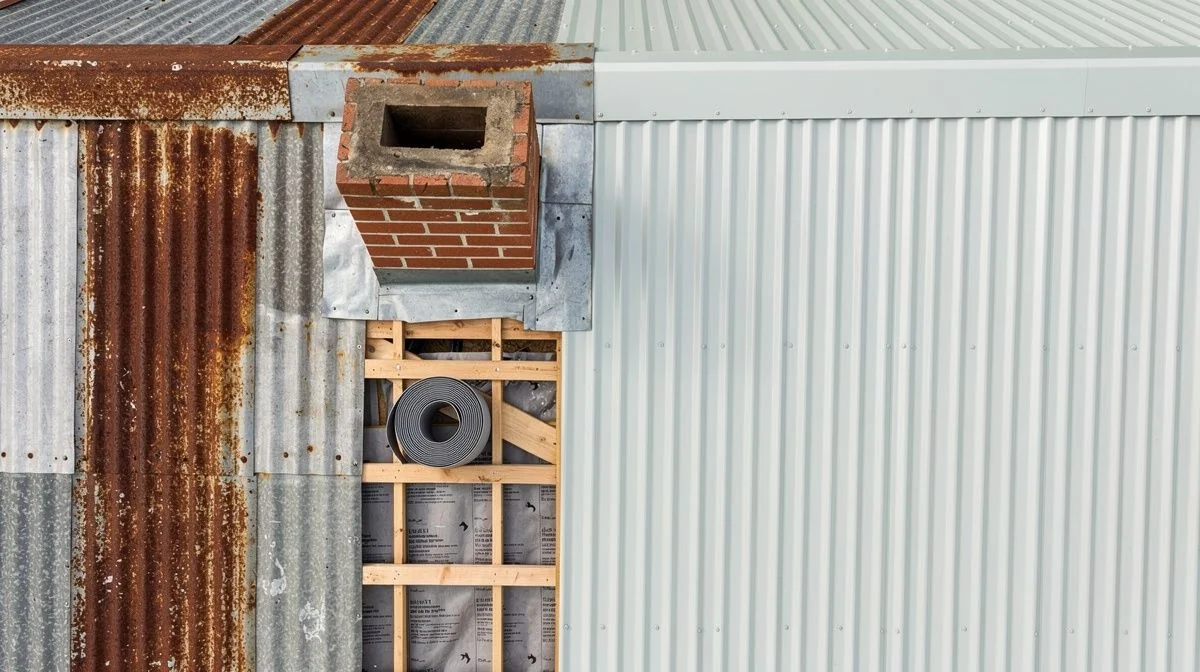
Leaks rarely come from the middle of a sheet. They come from valleys, penetrations, chimneys, changes of pitch and the flashings around them. Replacing the cladding without addressing the detail is the most common waste of money in roofing.
Roofing over rather than removing is the other one. It is faster and cheaper, and if the battens and fixings are not up to the job it is exactly the failure the Building Practitioners Board disciplined a Licensed Building Practitioner over. The Board cancelled his licence, though it chose not to name him publicly.
Consents, Durability and What the Law Actually Says
All building work needs a consent unless Schedule 1 of the Building Act 2004 exempts it. Exemption 1 covers general repair, maintenance and replacement — but only where comparable materials are used and the replacement goes in the same position.
The exclusions are what matter. They do not cover complete or substantial replacement of a component contributing to structural behaviour or fire safety. They do not cover repair or replacement of anything that has failed the Building Code's durability requirements. And they do not cover sanitary plumbing or drainlaying.
The 15-Year Rule in Practice
Building Performance's reasoning is worth reading twice: if a roof fails within the first 15 years, it did not meet its initial durability requirement, so it cannot be automatically replaced without a consent. The reason given is that a repaired roof using similar cladding, installed the same way as the original, may also fail.
Conversely, no consent is needed for normal re-roofing where the roof is more than 15 years old and like-for-like cladding is going back on. The durability periods more broadly are 50 years for structural elements and 15 years for wall and roof claddings — which is why a repair reaching into the framing changes the position.
Worked Examples We Did Not Invent
| Scenario | Consent needed? | Why |
|---|---|---|
| Replacing 20-year-old profile metal cladding with comparable profiled metal | No | Cladding achieved its durability requirement; comparable component, same position |
| Replacing clay tile with profiled metal in the same position | No | Not a substantial replacement of a structural component, though uplift must be considered |
| Replacing a leaking 12-year-old waterproof membrane roof with longrun corrugated metal | Yes | Existing cladding failed its 15-year durability requirement |
| Roofing over existing cladding with thin battens and inadequate fixings | Exempt work, but non-compliant | Exemption removes the consent, not the Building Code duty |
Quotes, Credentials and Getting It Right
Ask for a quote, not an estimate. A quote is a fixed price for defined work. An estimate is an approximation and can legitimately be exceeded. That difference is one of the most common sources of dispute on a roofing job.
A good written quote identifies what is included and what is excluded. On a roof, the items most likely to turn up later as variations are scaffolding, disposal of the old cladding, flashings, underlay and fixings. Ask about each one separately rather than assuming.
Checking the Person Doing the Work
Being a roofer is not a licensed occupation in itself. But Restricted Building Work must be done by a Licensed Building Practitioner, and the licence must be in the correct class for the work — a licensed practitioner in the wrong class is effectively unlicensed for that job.
Ask for the licence ID, which carries a QR code you can scan, or search the public register. The register shows the licence class, the area of practice, licence history and any discipline in the last three years. It takes minutes and it is free.
Also confirm whether the price includes GST. Two quotes that differ by 15 per cent may simply be quoting on different bases, which is an accounting difference rather than a price difference.
Questions You Might Have
Do I need a building consent to replace my roof?
If the existing cladding is more than 15 years old and you are replacing it like-for-like in the same position with a comparable material, no consent is needed under Schedule 1. If the roof failed inside 15 years, it cannot be automatically replaced without one. If you are unsure, ask your council before work starts.
Can my roofer just roof over the old cladding?
It is common because it is faster and cheaper, and it can be done properly. The failure mode is fixing over existing cladding with battens and fixings that are not adequate, which is the exact case where a Licensed Building Practitioner had his licence cancelled. Ask what is going underneath.
What warranty should I expect on a new roof?
Workmanship warranties are contractual promises and sit on top of your Consumer Guarantees Act rights rather than instead of them. A trader cannot contract out of those guarantees for consumer work, so a short warranty does not limit your statutory rights where a failure is substantial. Get the warranty in writing.
What if the framing is rotten once the roof is off?
This is the most common way a roofing job costs more than quoted. Agree a written variation process before work starts, requiring your sign-off before extra work proceeds. Also ask whether the repair reaches into structural elements, because that changes both the durability period and the consent position.
Should I upgrade insulation while the roof is off?
It is efficient to do it then, because the roof is already open and the access is there. Ask for it as a separate line in the quote so you can see what it costs on its own. If the roof has leaked for years, the insulation may need replacing anyway.
What Matters Most
The single most valuable thing you can establish before anyone gets on your roof is how old the existing cladding is and whether it has lasted its 15 years. That answer decides the consent position, and the consent position decides who is checking the work.
After that, it is about scope. The visible area of a roof is a poor guide to price, because the labour sits in the details — valleys, penetrations, flashings and access. Ask what is included, ask what is excluded, and ask for it in writing.
And check the licence. It takes minutes, it is free, and it is the difference between hiring someone who can legally do the work and someone who cannot.

The ValueHub Team built this site because finding clear, unbiased financial information in New Zealand was harder than it should be. Every guide is based on real research — we compare the actual fees, terms, and fine print so you don't have to. Our tip: shop around every year, read the policy docs, and never assume loyalty gets you the best deal.— The ValueHub Team
Try our Calculators
Use these free tools to crunch the numbers:
KiwiSaver Fund Comparison
Compare fees, returns, and risk levels across every KiwiSaver fund — the most up to date data in New Zealand.
Currency Converter — USD to NZD
Convert US Dollars to New Zealand Dollars instantly. See the latest exchange rate and 30-day trend.
Mortgage Repayment Calculator
Calculate your weekly, fortnightly, or monthly mortgage repayments. Free NZ mortgage calculator — try different rates, terms, and repayment frequencies.
Compound Interest Calculator
See how your savings grow with compound interest over time. Free NZ compound interest calculator with yearly, monthly, and weekly compounding options.
Term Deposit Calculator
Calculate your term deposit returns before you lock in. Compare interest earned across different terms and rates with ValueHub's free calculator.
Savings Goal Calculator
Calculate how long it will take to reach your savings goal — and what monthly deposit you need to get there. Free NZ savings planner.
Related Articles
House Painting Costs in New Zealand
Plan house painting costs in NZ with this guide covering size, surface condition, paint quality, and location to budget accurately.
guideHow to Choose a Landscaper in New Zealand
Hiring a landscaper in NZ? Learn how to define your project, compare quotes, and avoid costly mistakes in this step-by-step guide.