Best Fencing Contractors in Tauranga
Published 11 September 2026 · Written by the ValueHub team · Reviewed by Steve Baron

Fencing in Tauranga: Salt Sets the Specification
Salt is the first thing a Tauranga fence has to survive. Sections around Mount Maunganui, the inner harbour, and the ocean beaches sit in a steady stream of salt-laden air, and it starts working on steel fixings and untreated timber from the day they are installed. Galvanised fixings, stainless where the budget stretches, and a stain system are the parts worth paying for. Bright steel nails will not last the distance here. Ground conditions change quickly over short distances. Sandy coastal soils drain well but hold a post poorly unless the footing is properly concreted, while volcanic soils inland can hide rock at shallow depth. Rock slows every hole and shows up on the invoice as extra labour, and both conditions are legitimate costs rather than padding. Ask what the quote assumes about your soil before you compare it with others.
The city is ringed by kiwifruit orchards, horticultural blocks and small farms tied to the Port of Tauranga economy. Those properties need a different fence from a suburban section: longer runs, stock-proof post-and-rail or netting, and gates wide enough for machinery. Tauranga's population is also older than the national average, and many owners commission the work rather than doing it themselves. In that situation, a written specification matters more than a cheap headline rate.
How We Researched This Guide
We started with the Fencing Act, because it decides who pays when a boundary needs attention and how a disagreement is meant to be worked through. Then we worked through the fencing materials sold in New Zealand and the price bands contractors publish for supply and installation.
Local context came from public property value data for the Tauranga area and from the conditions that shape work here — coastal exposure, sandy and volcanic soils, and the mix of retirement housing, orchard land and lifestyle blocks on the city fringe. Ranges are kept as ranges wherever the sources disagree.
Our Trusted Fencing Contractors
We feature businesses that demonstrate strong performance, proven experience, and consistently positive customer feedback. Some of the providers listed may have commercial relationships with us, but all are selected based on quality and reliability.
To begin, reach out to them and speak with them directly — this helps you explain your job, ask questions, and confirm whether they're the right fit.
Bet big on DIY with Mitre 10 — New Zealand’s home of quality tools, smart home solutions, garden gear, and building essentials. From weekend projects to major renos, get trusted brands, sharp prices, and friendly expert advice. Make it happen with Mitre 10, your local Kiwi hardware powerhouse.
The 60-Second Version
Five things worth knowing before you ask anyone for a quote.
- A standard 1.8m treated-pine paling fence runs $150–$270 per lineal metre supplied and installed. Coastal Tauranga sites quote toward the top of that band.
- Colorsteel or corrugated fencing is $180–$300 per metre, PVC is $200–$350, aluminium slat is $250–$400, and rural post-and-rail is $80–$120.
- A full 50–80m paling boundary typically costs $10,000–$21,600. A single-side boundary of 15–25m runs $3,000–$6,750.
- Removing the old fence is a separate $25–$50 per metre. A pedestrian gate costs $400–$900, and a driveway gate costs $800–$1,500.
- Adjoining owners normally split the cost of a sufficient boundary fence under the Fencing Act, but only after written notice. Check the pegs and the services before anyone digs.
What Fencing Costs
These are the materials most Tauranga contractors quote for. Prices include supply and installation and exclude the cost of removing the existing fence.
| Fence type | Typical cost per lineal metre |
|---|---|
| Treated-pine paling, 1.8m | $150–$270 |
| Colorsteel or corrugated | $180–$300 |
| PVC or vinyl | $200–$350 |
| Aluminium slat | $250–$400 |
| Rural post-and-rail | $80–$120 |
| Glass pool fencing | $320–$800 |
Ranges drawn from published pricing for standard New Zealand residential fencing work. Quotes vary with access, ground conditions and material choice.
Height, length and access move the total more than most owners expect. A taller fence needs more material and presents a bigger face to the wind. A longer run spreads the setup cost and lowers the rate per metre, while a boundary the crew has to hand-carry to does the opposite.
The Common Fence Types and Where Each Fits
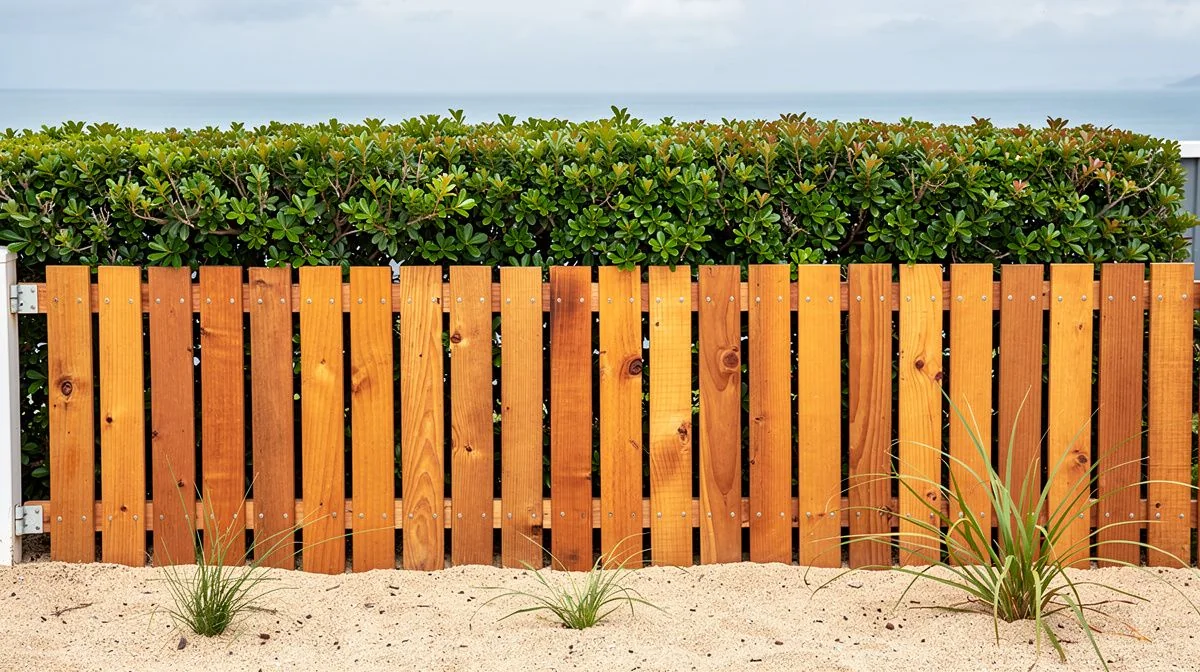
Treated-pine paling is the default residential boundary. It is the cheapest solid option; it repairs board by board, and it handles a stepped line on sloping ground. On the coast, specify treated timber with galvanised or stainless fixings; the extra cost is small next to replacing a fence early.
Colorsteel and corrugated steel at $180–$300 per metre ask almost nothing of you afterwards. On an exposed harbour or beachfront site, they usually earn the premium, because salt has nothing to rot. PVC sits at $200–$350 with similar durability, though its clean lines can look out of place on an older street.
Aluminium slat at $250–$400 per metre is the modern horizontal option: slim, private and low maintenance. Rural post-and-rail at $80–$120 per metre is the cheapest build and the right one on an orchard or lifestyle block, where containment matters far more than screening.
Pool fencing answers to its own rules. It must comply with safety standard NZS 8500 and include a self-latching gate, and glass panels cost $320–$800 per metre. The Ministry of Business, Innovation and Employment publishes the pool safety guidance that applies nationwide.
Local Factors That Change a Tauranga Quote
Salt Air and Fixings
Sections around Mount Maunganui, the inner harbour and the ocean beaches sit in a steady salt stream. Bright steel nails and untreated timber will not last there. Galvanised fixings, stainless where the budget allows, and a stain system are the parts worth paying for.
Sandy and Volcanic Ground
Ground conditions change over short distances here. Sandy coastal soils drain well but hold a post poorly unless the footing is properly concreted. Volcanic soils inland can hide rock at shallow depth, which slows every hole and appears on the invoice as extra labour. Both are legitimate costs, not padding.
An Older, Downsizing Population
Tauranga's population is older than the national average, and many owners are commissioning work rather than doing it. In that market, a written specification matters more than a cheap headline rate, because the person paying may not be the one who notices a shallow post a few years later.
Horticulture and the Rural Fringe
The city is ringed by kiwifruit orchards, horticultural blocks and small farms tied to the Port of Tauranga economy. Those properties need different fencing from a suburban section: longer runs, stock-proof post-and-rail or netting, and gates wide enough for machinery.
Choosing a Fencing Contractor in Tauranga
Ask for a written quote that separates the material, post spacing, footing depth, fixing,s and removal of the old fence. A single lump sum tells you nothing about what you are buying. On a slope, ask how the line is stepped and how the height is measured.
Fencing is not a licensed trade, so there is no public register to check. Local references carry the weight instead. Confirm the firm holds public liability cover and can point to recent work in your suburb, ideally on a site as exposed as yours.
Warning Signs
- A quote well below the others with no explanation for the gap.
- No written specification, or one that names no materials.
- Bright steel or staples offered as standard on a coastal site.
- Posts concreted only at the ends of the run and rammed elsewhere.
- No mention of who removes and disposes of the old fence.
Boundary Fences and the Fencing Act
The Fencing Act covers a fence on the boundary between adjoining properties. Where the fence is sufficient for its purpose, each owner normally pays half. It does not have to be the best fence available; it has to be adequate for the job.
Written notice is what makes the sharing rule work. Before any work starts, give your neighbour a written description of the fence you propose and the share you are asking them to contribute. Cover the height, material, and design in enough detail to be quoted, keep a copy, and note how you delivered it.
If the neighbour agrees, both are bound by what was agreed. If they object or say nothing, the matter continues from the notice rather than from a conversation over the fence. Retaining walls, pool barriers and fences built entirely inside your own boundary sit outside the sharing rule.
Pegs, Services and the Ground About to Be Broken
A fence follows a legal boundary, and that boundary is marked by survey pegs, not by the fence that is already there. Fences drift off the line and then get rebuilt along the same wrong line for decades. If the pegs are buried or missing, have the boundary re-established before work begins.
Underground services are the other check. Power, gas, water, telecommunications and fibre run close to boundaries in places, and post holes go down deep. Have the contractor book a service location before the first hole is dug, and be there when they peg out the line.
Questions You Might Have
How long will a coastal fence last?
Inland, a treated-pine paling fence with galvanised fixings should reasonably give fifteen to twenty years. Within a few streets of the harbour or the surf beaches, expect less unless the fixings are stainless and the timber is stained. Steel and PVC handle salt better than timber
Do I need consent for a fence?
Most residential boundary fences don't need a building consent, but height rules, corner sightlines, and pool barriers are regulated. Ask the council if the fence is near a driveway corner or a pool. It is a cheap question with an expensive answer if you skip it.
What if my neighbour will not pay half?
The Act assumes an equal share for a sufficient fence, but it works through a process rather than force. Serve notice properly, keep records of every conversation and quote, and get advice if the answer is a flat refusal. Building the fence and invoicing afterwards rarely ends well.
Can I build it myself?
Nothing stops you, and on flat inland ground a paling fence is within reach of a careful home handyperson. The groundwork, the height rules and the neighbour's agreement are what catch people out. On an exposed or sloping site, specification is where DIY fences usually fall short.
What Matters Most in Tauranga
On the coast, specification beats price. A cheap fence with bright steel fixings and untreated posts will not survive the salt, and the savings at the start get spent again within a decade.
Start with our national fencing contractors guide for the wider picture, then take one written specification to three local firms. Combine that with your neighbour's written agreement, correctly located pegs and a services check, and most of the risk is gone before anyone digs.

The ValueHub Team built this site because finding clear, unbiased financial information in New Zealand was harder than it should be. Every guide is based on real research — we compare the actual fees, terms, and fine print so you don't have to. Our tip: shop around every year, read the policy docs, and never assume loyalty gets you the best deal.— The ValueHub Team
Try our Calculators
Use these free tools to crunch the numbers:
KiwiSaver Fund Comparison
Compare fees, returns, and risk levels across every KiwiSaver fund — the most up to date data in New Zealand.
Currency Converter — USD to NZD
Convert US Dollars to New Zealand Dollars instantly. See the latest exchange rate and 30-day trend.
Mortgage Repayment Calculator
Calculate your weekly, fortnightly, or monthly mortgage repayments. Free NZ mortgage calculator — try different rates, terms, and repayment frequencies.
Compound Interest Calculator
See how your savings grow with compound interest over time. Free NZ compound interest calculator with yearly, monthly, and weekly compounding options.
Term Deposit Calculator
Calculate your term deposit returns before you lock in. Compare interest earned across different terms and rates with ValueHub's free calculator.
Savings Goal Calculator
Calculate how long it will take to reach your savings goal — and what monthly deposit you need to get there. Free NZ savings planner.
Fencing Contractors in Other Cities
Latest Guides & Reviews
Kōura KiwiSaver Scheme Review
Kōura KiwiSaver review: 13 open funds, fund charges from 0.63 to 1.10 per cent, and net returns to 30 June 2026.
reviewMaritime KiwiSaver Scheme Review
Maritime KiwiSaver review: 3 open funds, fund charges from 0.61 to 0.76 per cent, and net returns to 31 March 2026.
reviewMAS KiwiSaver Scheme Review
MAS KiwiSaver review: 7 open funds, fund charges from 0.25 to 0.98 per cent, and net returns to 30 June 2026.
reviewArotahi KiwiSaver Scheme Review
Arotahi KiwiSaver review: 1 open fund, a 0.77 per cent fund charge, and net returns to 31 March 2026. What the Government register shows you pay and get back.