Best Roofers in Auckland
Published 19 August 2026 · Written by the ValueHub team · Reviewed by Steve Baron

Why a Good Roofer Matters in Auckland
Roofing is restricted building work in New Zealand. That means anyone who carries out or supervises the installation of a roof — and certain repairs to it — must hold a Roofing licence under the Licensed Building Practitioners (LBP) scheme, or be supervised by someone who does. It is one of the few trades where the law is genuinely on your side, but only if you check before you hire.
Auckland is a hard place to get a roof wrong. The city is humid, it rains a lot — well over a metre a year across most of the region — and large chunks of the housing stock are old, coastal, or both.
In the inner suburbs like Ponsonby, Grey Lynn and Mt Eden, you are looking at pre-1940s villas and bungalows with original clay-tile or corrugated-iron roofs. In the belt of homes built through the 1970s, 1980s and 1990s, thousands of Decramastic stone-coated steel roofs are now well past their useful life. On the coast — the North Shore, the eastern bays, the west coast — salt air chews through standard fixings surprisingly fast.
A standard re-roof on a three-bedroom Auckland home typically costs $15,000 to $45,000, depending on the material and the difficulty of access. A small repair might only be a few hundred dollars.
That repair fee is modest compared with the cost of leaving a roof to leak. A failed flashing or a few cracked tiles on a Mt Eden bungalow becomes a sodden ceiling and rotted framing, and the bill is suddenly four figures before you have touched the roof itself.
How We Researched This Guide
We put this guide together by working through the actual rules and real-world pricing, not by guessing. We read the Licensed Building Practitioners scheme requirements and the Roofing licence class competencies to explain exactly what a licence covers, and we checked the LBP public register to show you how to verify a roofer in about 30 seconds.
For pricing, we dug into published cost guides from multiple Auckland roofing companies and cross-checked them against each other — the ranges below reflect those sources, not a single quote. We also read what the Roofing Association of New Zealand expects of its members, so we could explain what that membership actually means. If a number is on this page, we found a real source for it. If we could not verify something, we left it out.
Our Trusted Roofers
We feature businesses that demonstrate strong performance, proven experience, and consistently positive customer feedback. Some of the providers listed may have commercial relationships with us, but all are selected based on quality and reliability.
To begin, reach out to them and speak with them directly — this helps you explain your job, ask questions, and confirm whether they're the right fit.

Roofing Industries | NZ's Metal Roofing & Cladding Manufacturer New Zealand's leading metal roofing & cladding manufacturer Locally designed and manufactured metal roofing, cladding, fencing and rainwater products for residential and commercial application.
The Quick Summary (60-Second Version)
If you are in a hurry, here is the whole guide in six lines.
- Typical cost: a standard three-bedroom re-roof in Auckland runs $15,000–$45,000; a simple repair is usually $200–$900.
- How long: a full re-roof takes a few days to a couple of weeks; a flashing or tile repair usually takes a day.
- Best value for most homes: Colorsteel long-run steel — the cheapest per square metre and it sheds Auckland's rain well.
- What to check: the roofer's LBP Roofing licence number on the public register, plus RANZ membership as a quality signal.
- The biggest factor: coastal exposure — near the sea, insist on marine-grade fixings.
- The mistake to avoid: letting a small leak sit — a few hundred dollars now beats a few thousand later.
Roofer Licensing & Regulation — What Actually Matters
In New Zealand, roofing is restricted building work. The person who carries out or supervises the installation of a roof on a home must be licensed in the Roofing class under the LBP scheme, or be supervised by someone who is. There is no wriggle room here — it is the law under the Building Act, and it exists because a badly done roof is both dangerous and expensive to put right.
The Roofing licence is not one catch-all. It is split into seven areas of practice, and a roofer is only licensed for the ones they have actually been assessed in. If your roof is clay tile and the roofer is only licensed in profiled metal, that is the wrong roofer for the job.
| Roofing area of practice | What it covers |
|---|---|
| Profiled metal roof and wall cladding | Long-run steel, corrugated iron, standing seam |
| Concrete or clay tile roof | Tile roofs on character and modern homes |
| Metal tile roof | Decramastic-style stone-coated steel tiles |
| Roof membrane | Flat and low-pitch membrane roofs |
| Torch-on roof membrane | Torch-on membrane systems |
| Liquid membrane roof | Liquid-applied membrane coatings |
| Shingle or slate roof | Shingle and slate roofing |
One quirk worth knowing: registered plumbers and gasfitters are automatically treated as if they are licensed in roofing, because fitting and sealing pipework through roofs and walls is part of their trade. So a plumber sealing a small flashing around a pipe penetration may not need a separate roofing licence — but a plumber quoting a full re-roof is a different story.
The Roofing Association of New Zealand (RANZ) is the trade body. This incorporated society has represented roofing businesses for more than three decades and now counts more than 300 member companies. It is not a regulator, but membership means the business has been vetted against workmanship and conduct standards and has access to a dispute resolution process. Think of it as a useful second signal, not a substitute for an LBP licence.
Checking is free and takes about 30 seconds. Ask for the roofer's full name and LBP number, then search the public register to confirm they are licensed, which areas of practice they hold, and whether they have been disciplined in the last three years.
Auckland Pricing — What You Can Expect to Pay
Auckland pricing runs a little above the national average — most sources put the labour premium at roughly 10–15 per cent, driven by demand and the access headaches that come with the city's two-storey homes and steep sites. What you pay depends far more on material and roof shape than on anything else.
| Job | Typical cost |
|---|---|
| Roof inspection or call-out | $80–$250 (often credited if you proceed) |
| Minor leak repair (single point) | $200–$500 |
| Flashing repair or reseal | $250–$900 |
| Broken tile replacement | $150–$600 |
| Ridge capping re-bed and re-point | $400–$1,500 |
| Gutter repair or replacement | $150–$600 |
| Valley gutter replacement | $400–$1,200 |
| Partial re-roof (larger section) | $1,500–$5,000 |
| Emergency or after-hours call-out | $120–$400 plus hourly rate |
| Full re-roof — Colorsteel long-run (per m²) | $90–$180 |
| Full re-roof — metal tile (per m²) | $110–$200 |
| Full re-roof — concrete tile (per m²) | $120–$250 |
| Full re-roof — clay tile (per m²) | $150–$350 |
| Standard three-bedroom full re-roof | $15,000–$45,000 |
Price ranges verified from multiple Auckland roofing providers and industry cost guides as of August 2026. Final quotes depend on roof size, pitch, access, material, and the condition of what is underneath.
The biggest driver is material — long-run, Colorsteel is the cheapest at $90–$180 per square metre installed, while clay tile runs $150–$350 per square metre. But access is the silent cost. A steep roof costs noticeably more to work on safely than a shallow one, and a two-storey home on a tight site needs scaffolding or edge protection that a single-storey bungalow does not. Then there is what the roofer finds underneath: rotten timber, perished underlay, or rusted fixings, all of which add to the bill once the old cladding is off.
Most roofers quote a fixed price for a defined job, and that is what you want — an itemised written quote covering materials, labour, disposal, and scaffolding. Hourly rates are more common for small repairs and call-outs where the scope is not clear until someone is up on the roof. Either way, check whether the quote is GST-inclusive. Most Auckland roofers quote including GST, but not all, and it is a 15 per cent surprise you do not want at the end.
How to Choose a Roofer — What Actually Matters
Do not take a roofer's word that they are licensed — check it. Get their full name, look them up on the LBP register, and confirm their areas of practice match the job. A roofer licensed in profiled metal should not be quoting a torch-on membrane roof.
Ask specifically about experience with your type of home. A roofer who mostly does new-build Colorsteel in Flat Bush is not necessarily the right person for clay tile restoration on a Ponsonby villa, and a good roofer will tell you that before you have to work it out yourself.
Some roofers also hold other licences or work alongside builders and electricians. For a re-roof that involves rewiring, skylights, or structural work, it helps if the roofer has a network of trades they coordinate with — it keeps the job moving and keeps you off the phone.
Ask about emergency and after-hours availability before you need it, because roof leaks love long weekends. Also confirm they hold current public liability insurance and can provide a written record of work for restricted building work — you will want that paperwork when you sell.
Here is what should make you walk away:
- No LBP number, or one that does not appear on the register. That is an instant fail, full stop.
- A quote that is dramatically cheaper than the others. Cheap roofs usually skip scaffolding, underlay, or proper fixings.
- Pressure to sign today with a big deposit. Reputable roofers provide a written quote and give you time to think.
- "We do not need scaffolding" on a steep or two-storey Auckland home. That is a red flag for safety and liability.
- Vague about what happens if they find rotten timber or a leaky underlay. Every honest roofer has a clear answer, because it happens constantly.
What to Expect When You Call a Roofer
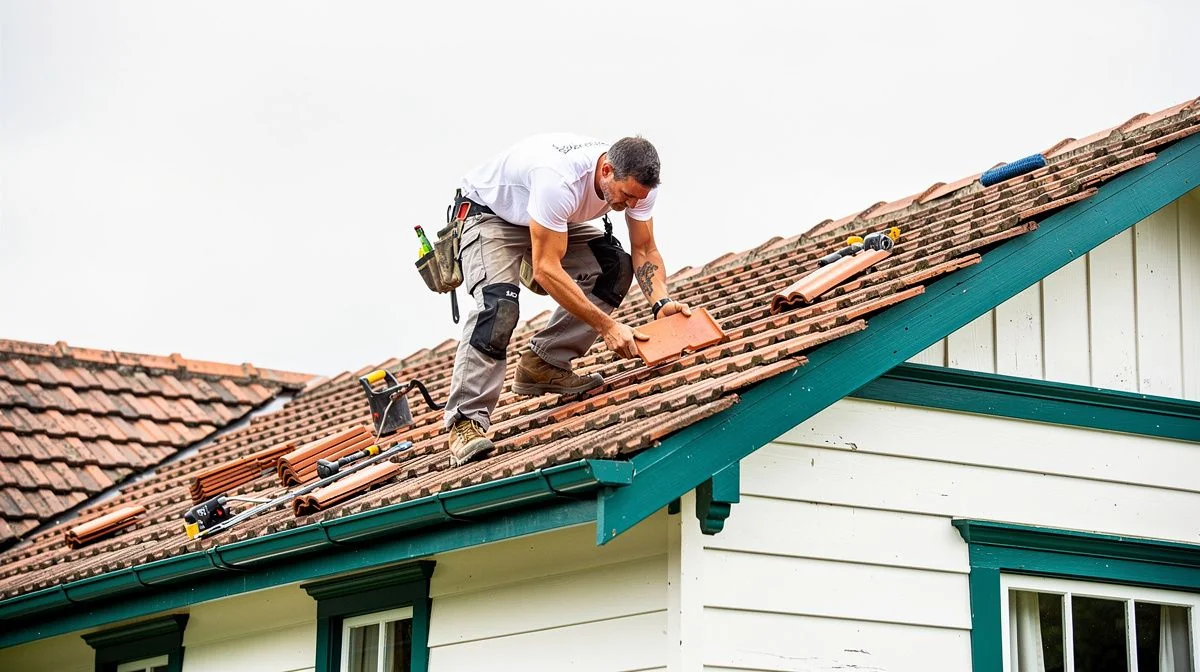
When you call, be ready to describe the problem in plain terms — where the leak is coming from, what the roof is made of, roughly when it started, and whether you have had work done on it before. A few photos from the ground help the roofer bring the right gear and, often, the right parts. If it is a leak, clear the area below it inside and put down a bucket or towels while you wait.
Expect the roofer to inspect first, not just start patching. They will look at the roof covering, the flashings around chimneys, skylights and penetrations, and often the ceiling space below to trace where water is actually getting in. From there you should get a clear explanation of what is wrong, what it will cost, and what is urgent versus what can wait.
How long common jobs take, as a rough guide:
- Simple tile or flashing repair: half a day to a day.
- Ridge capping re-bed and re-point: one to two days.
- Gutter replacement: about a day for a standard single-storey home.
- Partial re-roof of a section: one to three days.
- Full re-roof on a standard single-storey home: three days to two weeks, depending on size, material and weather.
- Membrane roof on a flat or low-pitch roof: one to two weeks including curing.
At the end, the roofer should hand over a record of work for restricted building work, any product warranties, and a clear list of what was done. Keep these — the record of work matters if you ever sell, and the warranty is only useful if you can prove who did the work and when. Do a final walk-around and check for leftover debris, especially nails and offcuts in the garden and gutters.

Auckland-Specific Risks & Local Factors
Roofing in Auckland is not one trade — it is several, depending on where you live and what your home is made of. These are the local factors a good Auckland roofer will ask about.
Coastal corrosion
If you are close to the sea — the North Shore, the eastern bays, the west coast, or the Manukau Harbour edge — salt air is working on your roof all year. It attacks metal roofing and, crucially, the fixings. Standard zinc-coated screws can fail within five to ten years in a marine environment, so the fix is marine-grade stainless steel fasteners and a coating like Colorsteel Maxx or Endura on the sheets themselves. Surfaces that do not get washed by rain, such as those under eaves and behind gutters, corrode fastest. If your home is coastal, say so up front and ask what marine-spec products they would use.
Character homes and their roofs
Auckland's inner suburbs hold the country's biggest concentration of pre-1940s villas and bungalows, and their roofs are a specialist job. Ponsonby, Grey Lynn and Mt Eden are full of clay tile and heritage-profile corrugated iron that needs restoration, not wholesale modern replacement — matched tiles, re-bedded ridge capping, hand-formed flashings. Then there is the Decramastic belt: homes built through the 1970s, 1980s and 1990s often carry stone-coated steel tiles that are now at or past the end of their service life. If you are in one of these, look for a roofer who is genuinely comfortable with the material, not one who wants to strip it all off.
Rain, humidity and moss
Auckland gets more than 1,200mm of rain a year, and the humidity that comes with it is a roofer's full-time enemy. Moss and lichen take hold on shaded roof faces, hold moisture against the surface, and slowly lift tiles and cladding. Blocked gutters then back water up into the eaves. The pattern that works is a visual check twice a year — after autumn leaf fall and again in spring — and a professional inspection every couple of years so small issues get caught before they become leaks.
Access and steep sites
Auckland's volcanic landscape means many homes sit on slopes or span multiple levels, which changes both what a roof costs and who should do it. Steep pitches and tight sites — think Mt Eden, Takapuna, or the western ranges — need scaffolding or edge protection that a flat, accessible roof does not, and that shows up in the quote. A roofer who glosses over access is either underquoting or planning to cut corners on safety, and either way, it becomes your problem.
Questions You Might Have
Do I need to be home while the roof is done?
Not usually. Roofing is external work, so you can be out as long as the roofer can access the site and you have sorted power and water. Most roofers are fine with you leaving once they have confirmed the plan — but agree on access and a contact number first, and expect them to flag anything unexpected the same day.
Can a roofer work in the rain?
Mostly no, and a good one will not pretend otherwise. Installation generally requires a dry roof so that a wet week can push a job out. Repairs that involve sealing or membrane work also need dry conditions. A roofer who works through heavy rain is usually creating the next leak.
How long should a roof last?
It depends on the material. Long-run steel is commonly warranted for 40 years or more with the right coating; concrete and clay tile can last 50 years or more, and a membrane roof on a flat or low-pitch roof is more like 20 to 30 years before it needs attention. Auckland's coastal, humid conditions pull all those numbers down without regular maintenance.
Is it worth repairing, or should I replace?
If the roof covering is in decent shape and the problem is localised — a failed flashing, a few cracked tiles, a section of ridge capping — repair usually makes sense. If the roof is 40-plus years old, the damage is widespread, or you are chasing a new leak every winter, replacement often costs less over the next decade than repeated patching. A good roofer will show you the maths on both.
What is the difference between a roofer and a builder doing a roof?
Roofing is restricted building work, so anyone doing or supervising the roof needs a Roofing LBP licence. A builder without that licence should not be re-roofing your home — they would need to be supervised by someone who holds it. It is a simple thing to check on the register.
What Matters Most
A roof is the one part of your home where a small, cheap fix and a total disaster sit a few millimetres apart. A $300 flashing reseal now is the difference between a dry ceiling and a $3,000 repair with rotted timber behind it. Get it wrong, and Auckland's rain will find it, every single time.
In Auckland, that is truer than almost anywhere — between the coastal salt, the moss-friendly humidity, and a housing stock that runs from 1920s villas to 1990s Decramastic, there is no one-size-fits-all answer.
Check the licence, get written itemised quotes from a couple of roofers, and ask about the things that matter for your specific home — coastal spec if you are near the sea, restoration experience if it is a character home. Do that, and a roof that is properly done will quietly outlast everything else you own.

The ValueHub Team built this site because finding clear, unbiased financial information in New Zealand was harder than it should be. Every guide is based on real research — we compare the actual fees, terms, and fine print so you don't have to. Our tip: shop around every year, read the policy docs, and never assume loyalty gets you the best deal.— The ValueHub Team
More Roofers in Auckland
These businesses also operate in this area.
#1 Rated Auckland Roofers. Top Rated Roofing Contractors with 120+ 5-star reviews. Best Roofing Auckland Wide. Contact us for a Fast, FREE Roof Replacement Quote. Auckland's No.1 Roofer with 150+ 5 Star Reviews on Google. Please enable JavaScript in your browser to complete this form. Name * Email Address * Contact Number * Address Your Message Phone Get A Free Roofing Quote.
At Aotearoa Roofing, we aim to be the experts you trust when your roof needs maintenance work or repairs. As one of the premier roofing companies in the local area, we offer superior workmanship for domestic, commercial and industrial clients. Specialising in installing new roofs, replacing existing structures, repair and maintenance work, whatever you need we have covered.
Looking for expert Roofers in North Shore? Archer Roofing specializes in the installation of metal roofing. We don’t treat our clients like numbers. Auckland roofing contractors that make your roof happy & healthy. Kevin and his team did an excellent job within budget and on time as promised. Highly recommend if you are after quality workmanship and good pricing.
Try our Calculators
Use these free tools to crunch the numbers:
KiwiSaver Fund Comparison
Compare fees, returns, and risk levels across every KiwiSaver fund — the most up to date data in New Zealand.
Currency Converter — USD to NZD
Convert US Dollars to New Zealand Dollars instantly. See the latest exchange rate and 30-day trend.
Mortgage Repayment Calculator
Calculate your weekly, fortnightly, or monthly mortgage repayments. Free NZ mortgage calculator — try different rates, terms, and repayment frequencies.
Compound Interest Calculator
See how your savings grow with compound interest over time. Free NZ compound interest calculator with yearly, monthly, and weekly compounding options.
Term Deposit Calculator
Calculate your term deposit returns before you lock in. Compare interest earned across different terms and rates with ValueHub's free calculator.
Savings Goal Calculator
Calculate how long it will take to reach your savings goal — and what monthly deposit you need to get there. Free NZ savings planner.
Roofers in Other Cities
Latest Guides & Reviews
KiwiSaver and Tax — PIR, ESCT and What You Actually Pay
KiwiSaver is taxed twice — ESCT on your employer's contribution and your PIR on the fund's returns. How each rate is set, and the two most members never check.
reviewInvestNow KiwiSaver Scheme Review
InvestNow KiwiSaver review: 45 open funds, fund charges from 0.03 to 1.38 per cent, and net returns to 30 June 2026.
reviewKernel KiwiSaver Scheme Review
Kernel KiwiSaver review: 25 open funds, fund charges from 0.25 to 0.45 per cent, and net returns to 30 June 2026.
guideTax Debt in New Zealand — The Numbers
Official figures on New Zealand's overdue tax debt: the total, the collectable share, which customer groups hold it, and how much is repaid or written off.