Best Tyre Retailers in Rotorua
Published 27 January 2025 · Updated 18 August 2026 · Written by the ValueHub team · Reviewed by Steve Baron

Best Tyre Retailers in Rotorua
Geothermal air, cold mornings and a lot of four-wheel drives
Rotorua presents a combination that tyre fitters elsewhere in the country do not deal with. The city sits on an active geothermal field, and the hydrogen sulphide that gives the place its smell is present in the air year round. Rubber is not immune to it: prolonged exposure to sulphur compounds contributes to the ageing and hardening of tyre rubber, which is exactly the process that makes an old tyre grip poorly even when it still has tread left.
Add the climate. Rotorua's winters bring heavy frosts and cold, damp mornings, and a tyre that has hardened with age has noticeably less grip on a cold, greasy surface than it did when it was new. The combination of ageing rubber and cold roads is what makes tyre condition here a safety matter rather than a maintenance schedule.
The vehicle mix rounds it out. Rotorua is a base for lakes, forest roads and outdoor work, so a good share of the local fleet is four-wheel drive and light commercial. Those vehicles run large, heavy tyre sizes and put different demands on a tyre than a small hatchback commuting around town, which is why all-terrain and light-truck fitments are more common here than in a big city.
How We Researched This Guide
We began with price, because it is the first question and one that is often answered with a figure that turns out not to include fitting. That meant collecting published price bands from tyre retailers and repairers across the country, sorting them by size and category, and separating the tyre price from the charges around it. On a set of four, those extras add a genuine amount.
We also read the warrant of fitness requirements for tyres, because the legal tread minimum is a specific figure that decides whether a vehicle passes. That led us into the tyre stewardship fee and the rules about how it appears on an invoice, which are clearer than most retailers treat them. Everything with a dollar sign, and both legal thresholds, were checked against live sources rather than estimated.
The 60-Second Version
If you only read one section of this page, read this one.
- Budget tyres run about $80–$150 each, mid-range $150–$250 and premium $250–$400.
- Four-wheel drive and all-terrain tyres commonly sit between $200 and $450 each.
- Fitting and balancing adds roughly $15–$25 per tyre.
- Rubber ages and hardens, so a low-mileage vehicle can need tyres that still have tread.
- The legal minimum tread is 1.5mm, measured around the whole circumference.
- A tyre stewardship fee must be itemised on your invoice and cannot be marked up.
What the Law Requires
Tyres have a hard legal threshold, which is unusual for a wearing part. A tyre on a vehicle capable of exceeding 30 km/h must have at least 1.5mm of tread depth around its whole circumference, measured in all the principal grooves that hold the moulded tread-depth indicators. Those indicators appear as raised bars inside the grooves, and the tyre has reached its limit when the tread wears level with them. Winter tyres must hold 4mm, since their purpose is grip in the conditions where a summer tyre gives up.
The 1.5mm figure is a failure threshold rather than a target. The New Zealand Transport Agency's tyre safety guidance is direct about this: more tread means better grip. A tyre on the legal limit still passes a check and still shifts far less water than the same tyre with 3mm remaining.
The second legal point is about what you are charged. Regulated tyres carry a stewardship fee that funds their collection and processing at end of life, set at $6.65 plus GST per equivalent passenger unit, with an ordinary car tyre counting as one unit. It must be shown transparently on the invoice and no mark-up is permitted.
The fee replaced the old ad hoc disposal charge: once the stewardship fee has been paid on a tyre, a separate end-of-life disposal charge must stop. Tyrewise sets out how the fee works, and a bill showing both a stewardship fee and a disposal charge on the same tyres is worth questioning.
What Tyres Cost in Rotorua
Size drives the price first, category second. The same vehicle can take a budget tyre or a premium one at two or three times the cost, and which you need depends on what you do with the vehicle.
| Size (common fitments) | Budget | Premium |
|---|---|---|
| 185/65R15 — Corolla, Swift, Fit | $80–$120 | $180–$250 |
| 205/55R16 — Mazda3, Civic, Golf | $100–$150 | $220–$320 |
| 225/45R17 — Camry, Accord, 3 Series | $120–$180 | $280–$400 |
| 235/55R18 — RAV4, CX-5, Outlander | $150–$220 | $320–$450 |
| 265/65R17 — Hilux, Ranger, Navara | $180–$280 | $350–$500 |
| Related service | Typical price |
|---|---|
| Budget tyre, per tyre | $80–$150 |
| Mid-range tyre, per tyre | $150–$250 |
| Premium tyre, per tyre | $250–$400 |
| All-terrain or 4WD tyre, per tyre | $200–$450 |
| Fitting and balancing, per tyre | $15–$25 |
| Wheel alignment, two wheel | $60–$90 |
| Wheel alignment, four wheel | $90–$150 |
| Tyre rotation | $30–$50 |
| Puncture repair | $25–$50 |
| New valve stem | $5–$15 |
| TPMS sensor replacement | $80–$150 each |
| Tyre stewardship fee | $6.65 plus GST per unit |
Ranges verified from published New Zealand retailer and repairer price guides as of September 2026. Larger and lower-profile sizes, performance fitments and run-flat tyres sit above these bands.
Work out the total before comparing anything. Four mid-range tyres at $180, fitting at $20 a corner and an alignment is a very different figure from the per-tyre price on the sign. Ask for a fitted total and ask which line items it covers.
How to Choose a Tyre Retailer
Start by reading the size off your own sidewall, in a format such as 265/65R17, and quote that when you ask for prices. A retailer who does not ask for it is guessing, and guessing is how the wrong load rating ends up on a four-wheel drive.
Then ask what the fitted price includes. Balancing, valve stems and the stewardship fee should all be in it. If they are not listed, the advertised price is not the price you will pay.
Five things worth walking away from:
- A disposal charge alongside a stewardship fee. The fee already covers end-of-life collection.
- Tyres with no visible date code. Every tyre carries its manufacturing date on the sidewall, and you should be able to read it.
- A load or speed rating below your vehicle's requirement. This matters more on a loaded four-wheel drive than most drivers realise.
- No alignment offered with a new set. New tyres on worn geometry scrub out quickly.
- Pressures set by eye. Correct figures are on the vehicle placard and they drive both wear and fuel use.
What Happens When You Book
A set of four tyres is usually an hour's work if you book ahead, and many Rotorua retailers offer a waiting area. Mobile fitting is available at a small premium if getting to a workshop is awkward.
What a proper appointment covers:
- Correct size, load rating and speed rating for the vehicle.
- Old tyres removed, new ones fitted and properly seated.
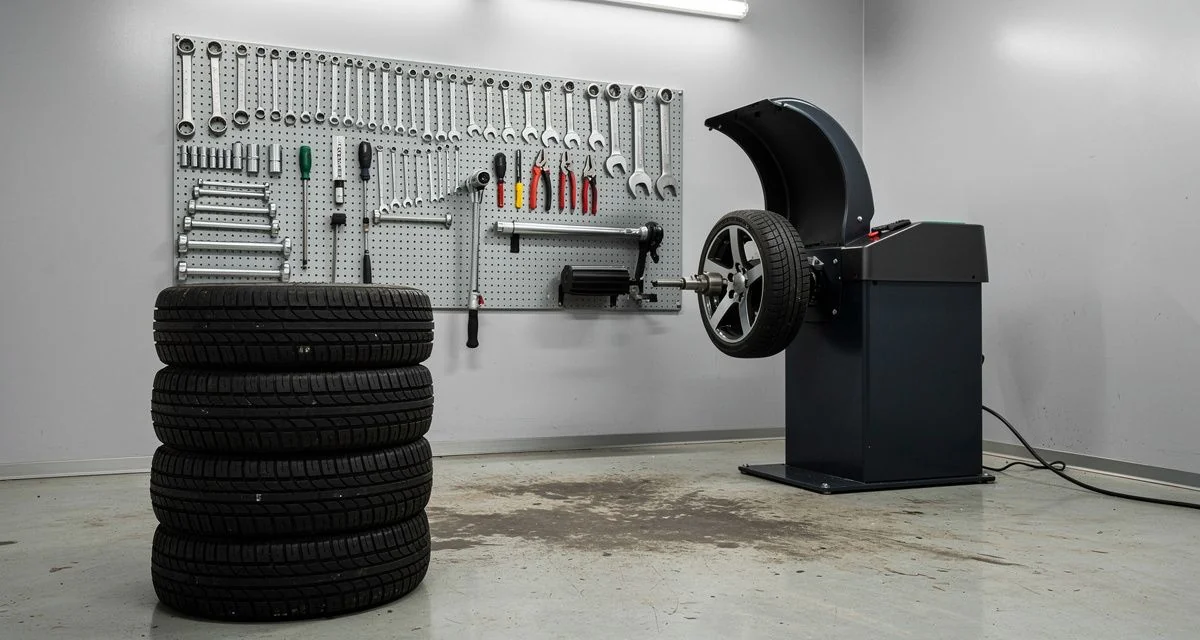
- Each wheel balanced on a machine.
- Valve stems replaced or inspected.
- Wheel nuts torqued to the manufacturer's specification.
- Pressures set to the placard values, spare included.
Ask to see the old tyres before they go. Wear across a tyre tells you what is happening underneath: both shoulders worn means under-inflation, the centre worn means over-inflation, and one edge worn means alignment. That information is free while the tyres are off the car and gone once they are in the bin.
What Rotorua Does to Tyres
Geothermal air and rubber ageing
Hydrogen sulphide is present in the local air, and sulphur compounds contribute to the ageing of rubber. The practical effect is that tyres here can harden and crack sooner than their tread depth would suggest. Check the sidewalls for fine cracking when you check the tread, and look at the date code, because on a low-mileage vehicle age is often the deciding factor.
Frosts and cold, greasy roads
Rotorua gets hard winter frosts, and cold roads reduce grip for every tyre. The difference between a fresh tyre and an aged one is most obvious on exactly those mornings. If your tyres are old and the tread is getting low, the cold months are the wrong time to wait.
Four-wheel drives and outdoor use
Lakes, forest roads and rural work mean a lot of all-terrain and light-truck fitments, and those tyres have different trade-offs from a road tyre: more grip off the seal, more noise and often faster wear on it. Be honest about how much of your driving is actually off-road before paying a premium for capability you will not use.
Questions You Might Have
How do I tell how old a tyre is?
Every tyre has a manufacturing date stamped into its sidewall as a four-digit code showing the week and year of production. A tyre can be years old before it is ever fitted, so check it. An aged tyre with good tread may still be a poor choice, particularly on a vehicle that only does short local trips.
Do I need all-terrain tyres for a four-wheel drive?
Only if you genuinely leave the seal regularly. An all-terrain tyre trades road grip, noise and wear rate for off-road traction. If most of your driving is town and highway with occasional gravel, a good road-oriented tyre will usually serve you better and cost less over its life.
Is a puncture worth repairing?
Usually yes if the damage is in the central tread area and the tyre has plenty of life left, because a proper repair from inside the tyre is a sound fix. Damage to the sidewall, or a puncture near the shoulder, normally cannot be safely repaired and the tyre should be replaced.
What Matters Most
In Rotorua, tread depth alone is not a good measure of whether a tyre is still safe. Rubber ages, and the geothermal air and hard frosts both punish an old tyre that looks serviceable. Check your tread, check the sidewalls for cracking, and check the date code.
Read your size off the sidewall, ask two or three local retailers for a fitted total including alignment and the stewardship fee, and compare the whole number.

The ValueHub Team built this site because finding clear, unbiased financial information in New Zealand was harder than it should be. Every guide is based on real research — we compare the actual fees, terms, and fine print so you don't have to. Our tip: shop around every year, read the policy docs, and never assume loyalty gets you the best deal.— The ValueHub Team
Try our Calculators
Use these free tools to crunch the numbers:
KiwiSaver Fund Comparison
Compare fees, returns, and risk levels across every KiwiSaver fund — the most up to date data in New Zealand.
Currency Converter — USD to NZD
Convert US Dollars to New Zealand Dollars instantly. See the latest exchange rate and 30-day trend.
Mortgage Repayment Calculator
Calculate your weekly, fortnightly, or monthly mortgage repayments. Free NZ mortgage calculator — try different rates, terms, and repayment frequencies.
Compound Interest Calculator
See how your savings grow with compound interest over time. Free NZ compound interest calculator with yearly, monthly, and weekly compounding options.
Term Deposit Calculator
Calculate your term deposit returns before you lock in. Compare interest earned across different terms and rates with ValueHub's free calculator.
Savings Goal Calculator
Calculate how long it will take to reach your savings goal — and what monthly deposit you need to get there. Free NZ savings planner.
Tyre Retailers in Other Cities
Latest Guides & Reviews
Kōura KiwiSaver Scheme Review
Kōura KiwiSaver review: 13 open funds, fund charges from 0.63 to 1.10 per cent, and net returns to 30 June 2026.
reviewMaritime KiwiSaver Scheme Review
Maritime KiwiSaver review: 3 open funds, fund charges from 0.61 to 0.76 per cent, and net returns to 31 March 2026.
reviewMAS KiwiSaver Scheme Review
MAS KiwiSaver review: 7 open funds, fund charges from 0.25 to 0.98 per cent, and net returns to 30 June 2026.
reviewArotahi KiwiSaver Scheme Review
Arotahi KiwiSaver review: 1 open fund, a 0.77 per cent fund charge, and net returns to 31 March 2026. What the Government register shows you pay and get back.