How to Build Your Credit Score in NZ
Published 13 May 2025 · Updated 23 February 2026 · Written by the ValueHub team · Reviewed by Steve Baron
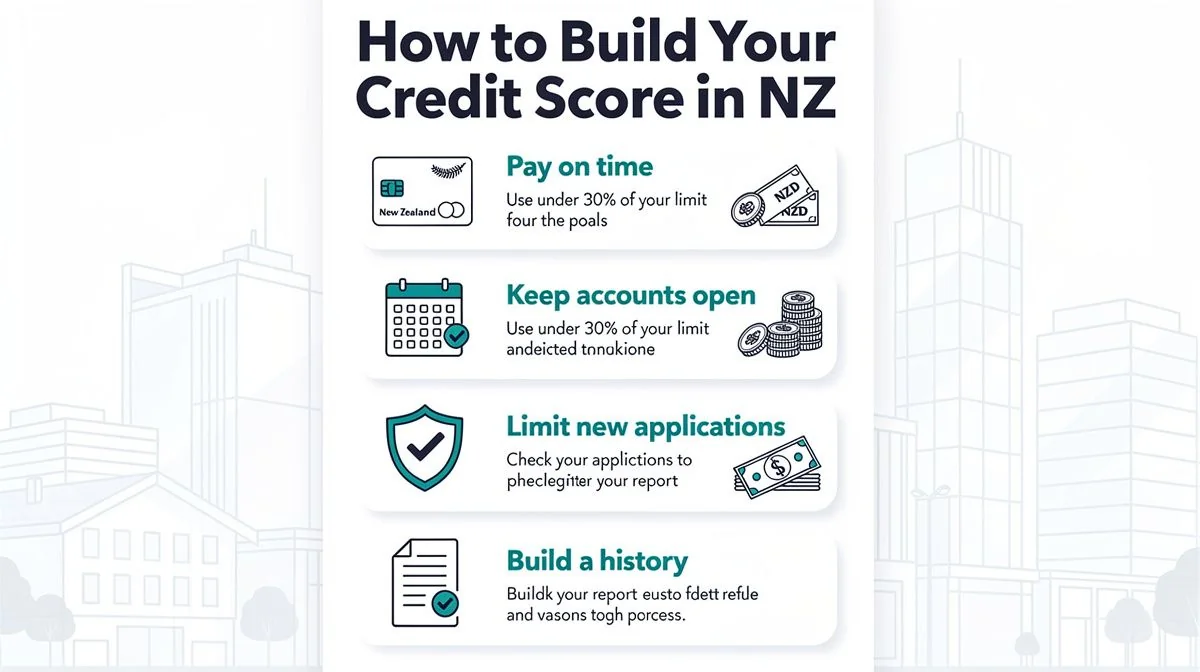
How to Build Your Credit Score in NZ
New Zealand does not have one credit score. It has three, and they probably disagree with each other. Equifax, Centrix and illion each keep their own file on you and each works out its own score from it. Lenders pull one or more of those files and then make their own call on top.
That changes what "building your score" actually means. You are not chasing a number. You are improving the raw data underneath it — the repayment history, the defaults, the enquiries — so that whichever bureau a lender happens to use, the story it tells about you is a good one.
There is also a hard gate most people miss. Under the Credit Contracts and Consumer Finance Act, a lender has to assess whether the borrowing is actually affordable for you. Income and expenses matter as much as the file does. A clean credit record will not carry an application that the numbers say you cannot service.
How We Researched This Guide
We went to the providers. Every rate, fee and interest-free term below was read off the issuer's own page or a dated fee schedule, not from a comparison table. That matters, because New Zealand card pricing moves quietly. The Credit Contracts and Consumer Finance Act 2003 is set out in full on legislation.govt.nz, and it is the reason lenders must disclose every rate and fee before you sign.
Two things surprised us. First, TSB's Low Rate Mastercard charges 11.95% p.a. on cash advances — the same rate as purchases. That is almost unheard of, given cash advances elsewhere run about 22% to 25% p.a. with a fee on top. Second, Gem Visa stopped applying its six months interest free automatically from 11 February 2026. You now have to select the purchase in the Latitude app within 30 days or you lose it entirely.
ValueHub's Trusted Providers
We've researched the providers below — here are our picks for this category.
Harmoney is often the most competitive for borrowers who don’t qualify for bank‑tier rates. Their risk‑based pricing means excellent credit gets very sharp rates, while average credit still gets fair pricing. Approval is fast, fully online, and fees are transparent.
The Quick Summary (60-Second Version)
If you only read one part of this guide, read this bit.
- Three bureaus, three files. Check all three, because creditors do not report to all of them equally.
- Repayment history is the biggest single input. Set up automatic payments so it cannot be derailed by a busy week.
- Keep balances low relative to limits. A maxed card signals reliance on debt even when you pay on time.
- Space out credit applications. A cluster of hard enquiries reads as financial stress.
- A default stays on file for years, and paying it does not wipe it — it gets marked paid.
- Affordability rules mean your income and expenses are assessed alongside the file. Fix both.
What Lenders Actually Look At
Lenders weigh five things on your file: repayment history, defaults, credit enquiries, how many active accounts you hold, and how long your credit history runs. Of those, repayment history carries the most weight. It is also the one you control most directly, week to week.
The practical move is boring and effective. Put every recurring bill — power, phone, insurance, card minimum — on automatic payment. One missed payment through forgetfulness can sit on your file for years, and no amount of good behaviour elsewhere cancels it out. If you cannot clear a card in full, pay at least the minimum by the due date. That is the line that matters.
Credit utilisation, plainly
Utilisation is your balance divided by your limit. A card with a $5,000 limit and a $4,500 balance tells a lender you are leaning hard on borrowed money, even if you have never missed a payment. Paying balances down improves this faster than almost anything else you can do.
Closing old accounts is the counterintuitive part. A card you have held for a decade with a clean record is evidence of a long, stable relationship with credit. Shut it and you delete that evidence. Keep it open at a zero balance instead, or run one small recurring charge through it and clear it monthly.
Rates, Fees and the Interest-Free Trap
Standard rewards cards in New Zealand sit at roughly 19.95% to 22.49% p.a. on purchases. Low-rate cards run about 11.95% to 13.99% p.a. Cash advances are where it bites: typically about 22% to 25% p.a., plus a flat fee per withdrawal, and some cards add a percentage of the amount on top.
Interest is calculated daily on the outstanding balance, using the annual rate divided by 365. That is why a card balance left to sit costs more than the headline rate suggests, and why the interest-free window only opens if you clear the statement balance in full by the due date. Most cards give you somewhere between 44 and 55 days.
| Card | Purchase rate | Annual fee | Interest-free days |
|---|---|---|---|
| TSB Low Rate Mastercard | 11.95% p.a. | $20 | up to 55 |
| SBS Visa Credit Card | 19.65% p.a. | $0 | — |
| TSB Platinum Mastercard | 20.95% p.a. | $90 | up to 55 |
| ANZ Airpoints Visa | — | $65 | up to 44 |
| Gem Visa | 29.49% p.a. | $65 | 6 months on eligible purchases |
Note the Gem Visa row. That 29.49% p.a. is the prevailing rate once any interest-free term ends, and the six months is no longer automatic. You must select the eligible purchase in the Latitude app or service centre within 30 days of it being posted. Miss that window and you cannot select it later — the interest-free term is gone. Gem's own terms also warn that paying only the minimum will not clear the purchase within the promotional period.

Balance Transfers and the Order Your Money Lands In
A balance transfer moves an existing card balance onto a new card at a low or 0% promotional rate for a set period. Done well, it is one of the few genuinely useful tools for digging out of card debt. Done carelessly, it costs you more than the original card did.
The trap is the order of payments. The promotional rate usually applies only to the transferred balance. New purchases typically sit at the standard rate from day one, and if you keep spending on the card, your repayments can end up clearing the cheap balance while the expensive new spending compounds untouched. The promotional period also ends on a fixed date, not when the balance reaches zero. And the annual fee still applies throughout.
When a personal loan beats a card
A personal loan is a fixed sum, repaid over a fixed term, at a fixed rate. A credit card is a revolving limit at a variable cost. If you are carrying a balance you cannot clear, a loan usually costs less per dollar borrowed than a card's standard rate. ASB, for example, publishes a single fixed rate of 13.90% p.a. on amounts over $2,000, with no processing fee and no early repayment charge.
But a card costs nothing at all if you clear the statement balance every month. That is the whole comparison in one line: a loan is cheaper for debt you carry, a card is cheaper for spending you clear.
Questions You Might Have
Does checking my own credit file hurt my score?
No. You can request your own credit report from Equifax, Centrix or illion, and checking your own file does not affect it. Those are soft enquiries. Only applications from lenders are hard enquiries, and only those count against you.
How long does a default stay on my file?
Defaults remain visible for several years, and paying one does not remove it — it gets marked as paid and stays for the remainder of the retention period. Its weight fades over time. The only way to remove one early is to dispute it successfully on the grounds that it is wrong.
Should I close a credit card I never use?
Usually not. A long-held account with a clean payment history is evidence of stability, and closing it deletes that history. Keep it open at a zero balance, or put one small recurring charge on it and clear it each month so the account stays active.
Do Buy Now Pay Later payments affect my credit file?
Yes. BNPL providers report to the bureaus, so on-time instalments build positive history and missed ones land the same way any other missed payment would. The old idea that BNPL sits outside the credit system no longer holds.
Will a high limit I never use improve my score?
No. The limit itself is not a positive factor — it is the payment history on the account that counts. An unused card with a zero balance contributes nothing either way except the account age. What helps is using it lightly and paying it off.
What Matters Most
Nothing in this guide beats one habit: paying every obligation on time, every time, for years. Not a clever card, not a balance transfer, not a limit increase. A sustained pattern of on-time payment is the foundation, and it is the only input that compounds in your favour.
Everything else is maintenance. Check all three files once a year and dispute anything wrong. Keep balances low relative to limits. Space out applications. Stay on the electoral roll. None of it is dramatic, and that is rather the point.
And remember the gate you cannot see from your credit file. Lenders must assess affordability, so your income and expenses carry as much weight as your history. A strong file plus numbers that do not work still gets declined. Fix both sides of the application.

The ValueHub Team built this site because finding clear, unbiased financial information in New Zealand was harder than it should be. Every guide is based on real research — we compare the actual fees, terms, and fine print so you don't have to. Our tip: shop around every year, read the policy docs, and never assume loyalty gets you the best deal.— The ValueHub Team
Try our Calculators
Use these free tools to crunch the numbers:
KiwiSaver Fund Comparison
Compare fees, returns, and risk levels across every KiwiSaver fund — the most up to date data in New Zealand.
Currency Converter — USD to NZD
Convert US Dollars to New Zealand Dollars instantly. See the latest exchange rate and 30-day trend.
Mortgage Repayment Calculator
Calculate your weekly, fortnightly, or monthly mortgage repayments. Free NZ mortgage calculator — try different rates, terms, and repayment frequencies.
Compound Interest Calculator
See how your savings grow with compound interest over time. Free NZ compound interest calculator with yearly, monthly, and weekly compounding options.
Term Deposit Calculator
Calculate your term deposit returns before you lock in. Compare interest earned across different terms and rates with ValueHub's free calculator.
Savings Goal Calculator
Calculate how long it will take to reach your savings goal — and what monthly deposit you need to get there. Free NZ savings planner.
Related Articles
Balance Transfers Explained — A Step-by-Step Guide
Learn how balance transfers work in NZ, step by step. Save on interest and pay off credit card debt faster with this practical guide.
guideRewards Programmes in NZ — What to Look For
Compare NZ credit card rewards programmes from Airpoints to cashback. Learn what traps to avoid and find one that suits your spending.