Best Bathroom Renovators in Upper Hutt
Published 15 September 2026 · Updated 08 October 2026 · Written by the ValueHub team · Reviewed by Steve Baron

Best Bathroom Renovators in Upper Hutt
A lot of the housing here was built between the 1950s and the 1970s, and much of it still has the bathroom it was given then. Those rooms were designed to be small, tiled in a colour nobody wants back, and built without the mechanical ventilation that later regulations require.
The valley is damp, which is why an old bathroom here so often has more going on behind the wall than the owner knew. We have set out what each level of renovation costs, who is legally required to do the wet and electrical work, and the questions that separate a genuine quote from a cheap one.
How We Researched This Guide
We worked from published New Zealand renovation cost guides for 2026, then checked the component prices that make up those totals. Tiling and waterproofing are priced separately per square metre, and those two lines alone account for a large share of the bill, so a single headline figure obscures most of the decision.
The compliance side came from the Building Code and the licensing boards rather than from any marketing material. Waterproofing in a wet area is not optional and is not a detail the homeowner can waive, and the trades allowed to do the plumbing, drainage and electrical parts are set by statute.
Our Trusted Bathroom Renovators
We feature businesses that demonstrate strong performance, proven experience, and consistently positive customer feedback. Some of the providers listed may have commercial relationships with us, but all are selected based on quality and reliability.
To begin, reach out to them and speak with them directly — this helps you explain your job, ask questions, and confirm whether they're the right fit.
Buy online for delivery across New Zealand. Crown Bathrooms is your first choice when you are building or undertaking bathroom renovations. Crown Bathrooms, formerly known as Crown Showers, has been supplying quality and fashionable bathroom fittings and products in New Zealand for over 15 years.
The Quick Summary (60-Second Version)
If you want the short version before you ask anyone around, here it is.
- A cosmetic refresh that keeps the layout runs $5,000 to $12,000.
- A full strip-out and rebuild of a small bathroom or ensuite costs $15,000 to $25,000.
- A mid-range full renovation of an ordinary family bathroom sits at $20,000 to $35,000.
- Work out the budget per square metre at $2,500 to $5,000, then check it against the totals above.
- Waterproofing is a building code requirement, costs $800 to $2,000 on its own, and is not a line to trim.
- The mistake to avoid is accepting a quote that names no waterproofing system, because that is the part nobody can see afterwards.
Who Is Allowed to Do the Work
The renovation itself is not a licensed trade, but three parts of it are restricted. Plumbing and drainage work may only be done by someone licensed with the Plumbers, Gasfitters and Drainlayers Board, and every bathroom involves both. Electrical work, including the extract fan, the heated towel rail, and any underfloor heating, may only be carried out by a licensed electrician.
Where the job changes the structure or the building envelope, or adds a new window, the work is restricted building work and needs a Licensed Building Practitioners. That applies more often than people expect, because enlarging a bathroom or moving a wall is exactly the sort of change that crosses the line.
Waterproofing is regulated rather than licensed. Under the Building Code, the wet area must have a continuous waterproof membrane applied by an approved system, and councils usually require a producer statement from the applicator before they will sign off the work. Ask who will provide that statement, because it is the document that protects the job when the house is sold later.
Upper Hutt Pricing — What You Can Expect to Pay
Bathroom pricing is driven by fixed costs rather than floor area. Waterproofing, the plumbing rough-in, and the electrical work cost much the same in a three-square-metre ensuite as in a six-square-metre bathroom, so a small room carries a higher rate per square metre even though the total is lower.
The other decisive line is layout. Replacing the vanity and the toilet in the same positions is straightforward. Moving the shower or the toilet means new drainage, new waterproofing and usually a building consent, and that single change typically adds several thousand dollars and a week to the job.
| Item | Typical cost |
|---|---|
| Cosmetic refresh, layout unchanged | $5,000-$12,000 |
| Small bathroom or ensuite, full rebuild (3-5 m2) | $15,000-$25,000 |
| Mid-range full renovation (5-8 m2) | $20,000-$35,000 |
| High-end renovation with custom tiling | $40,000-$65,000+ |
| Per-square-metre working guide | $2,500-$5,000 per m2 |
| Waterproofing the wet area | $800-$2,000 |
| Standard ceramic tiling, labour and adhesive | $65-$90 per m2 |
| Large-format porcelain tiling | $90-$140 per m2 |
| Moving the toilet, shower or vanity | Quoted separately, consent likely |
Tiling prices cover labour and adhesive only; tiles are purchased separately. A quote that gives one total without separating the waterproofing, the tiling and the fixtures cannot be compared against another quote, so ask for those three lines by name before you decide anything.
How to Choose a Renovator — What Actually Matters
Ask which waterproofing system, and who signs it off
The membrane under the tiles is the part of the job you will never see again, and it is the part that fails expensively. Ask for the system by name and for the applicator's producer statement. A renovator who cannot answer that question is not the right person for a wet area, whatever the price.
Ask which parts of the price carry a licence
Plumbing, drainage, electrical and gas are all restricted work, and each carries a different licence number. Ask for those numbers on the quote. It tells you the job will be signed off by the right people, and which parts of the work are not being subcontracted to whoever is free that week.
Ask what happens if the framing behind the wall is rotten
In houses of this age, opening a bathroom wall sometimes reveals rotten framing around the shower or the old floor waste. Ask how that is priced. A renovator who quotes a fixed figure and then bills surprises is worse than one who names an hourly rate for unforeseen work and explains it up front.
What the Job Involves
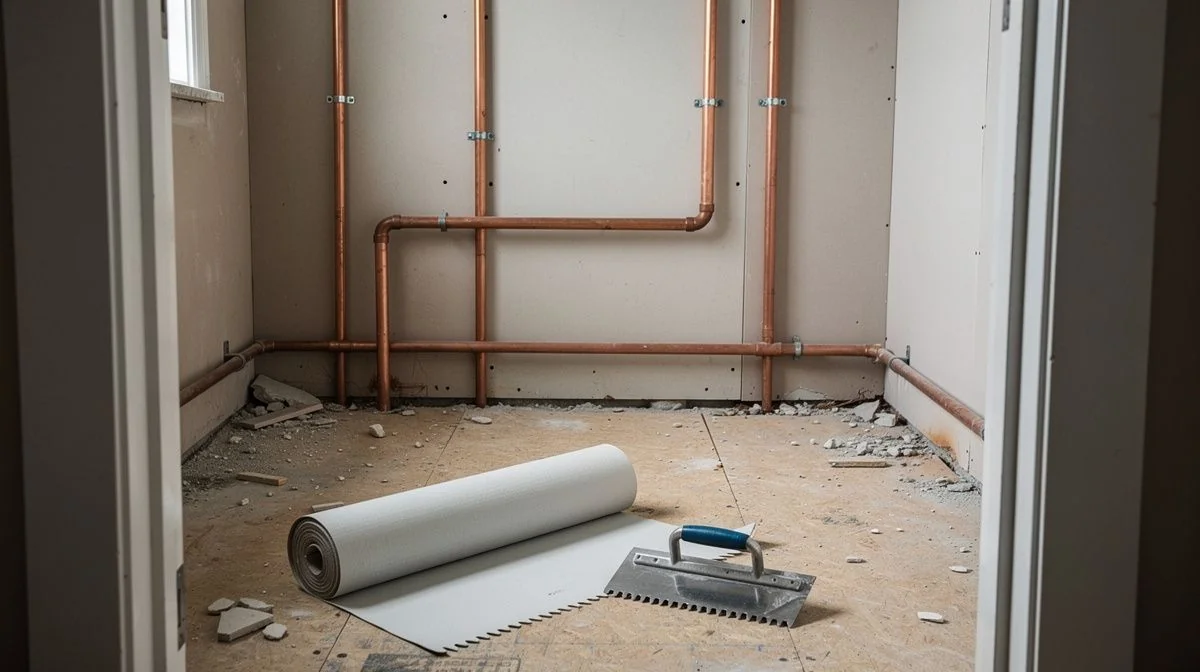
The order matters, and the parts that cannot be rushed are the parts you cannot see afterwards.
- The room is stripped out, and any consent or producer-statement paperwork is confirmed before demolition starts.
- The plumbing, drainage, and electrical rough-in is complete and inspected because this is the point at which changes are still cheap.
- The substrate is repaired, the falls to the floor waste are screeded, and the waterproofing membrane is applied, cured and tested.
- Tiling and the fixtures go in, then the extract fan is commissioned, and the electrical work is certified.
- Council inspections and any producer statements are issued, and the compliance documents are handed over with the warranty.
Upper Hutt-Specific Risks — What Your Renovator Should Know
Bathrooms built without mechanical ventilation
Houses from this era were often built with a window, and nothing else, and a window that stays shut in winter does not clear steam. Moisture then sits on cold surfaces and works into the linings. An exterior-ducted exhaust fan is a small part of the budget and one of the few that will affect how the room performs for the next twenty years.
Rot and damp that only appears once the wall is open
Around the shower and along the bottom plate, the timber can be soft long before anything shows on the painted side. Anyone quoting from a photograph is guessing. A renovator who opens the wall as part of the initial scope, rather than after the price is fixed, is the one whose final figure is likely to hold.
Asbestos in flooring and sheet linings
Vinyl flooring, its backing and some flat sheet linings in houses built before 2000 can contain asbestos, and a bathroom renovation disturbs exactly those materials. Removing it is regulated work. Ask how it will be identified and handled before the first hammer goes into the floor, and get that answer in writing.
Questions You Might Have
Do I need a building consent?
Replacing fixtures in their existing positions usually does not need one. Moving plumbing, adding a shower where there was none, altering structure or changing the building envelope does. The renovator should tell you which category your job falls into before work starts, because doing it the other way round is how renovations end up needing to be undone.
How long does a bathroom renovation take?
A straightforward strip-out and rebuild usually takes three to five weeks, and the waterproofing cure times cannot be shortened. Ordering fixtures late is the most common cause of a job running over, so make those decisions while the demolition is happening rather than after the framing is closed up.
Can I keep the layout and just replace the fittings?
Yes, and it is the single biggest saving available. Keeping the toilet, shower and vanity where they are avoids new drainage, new waterproofing over a larger area, and usually the need for consent. If the layout already works, spend the difference on waterproofing, ventilation, and tiling rather than on moving pipes.
What Matters Most
A bathroom is judged by what you cannot see: the membrane under the tiles, the fall to the waste, and the fan that actually removes the steam. Those three decide whether the next renovation happens in twenty years or eight.
Keep the layout if you can, insist on a named waterproofing system and a producer statement, and buy the ventilation rather than hoping the window is enough.

The ValueHub Team built this site because finding clear, unbiased financial information in New Zealand was harder than it should be. Every guide is based on real research — we compare the actual fees, terms, and fine print so you don't have to. Our tip: shop around every year, read the policy docs, and never assume loyalty gets you the best deal.— The ValueHub Team
Try our Calculators
Use these free tools to crunch the numbers:
KiwiSaver Fund Comparison
Compare fees, returns, and risk levels across every KiwiSaver fund — the most up to date data in New Zealand.
Currency Converter — USD to NZD
Convert US Dollars to New Zealand Dollars instantly. See the latest exchange rate and 30-day trend.
Mortgage Repayment Calculator
Calculate your weekly, fortnightly, or monthly mortgage repayments. Free NZ mortgage calculator — try different rates, terms, and repayment frequencies.
Compound Interest Calculator
See how your savings grow with compound interest over time. Free NZ compound interest calculator with yearly, monthly, and weekly compounding options.
Term Deposit Calculator
Calculate your term deposit returns before you lock in. Compare interest earned across different terms and rates with ValueHub's free calculator.
Savings Goal Calculator
Calculate how long it will take to reach your savings goal — and what monthly deposit you need to get there. Free NZ savings planner.
Bathroom Renovators in Other Cities
Latest Guides & Reviews
Kōura KiwiSaver Scheme Review
Kōura KiwiSaver review: 13 open funds, fund charges from 0.63 to 1.10 per cent, and net returns to 30 June 2026.
reviewMaritime KiwiSaver Scheme Review
Maritime KiwiSaver review: 3 open funds, fund charges from 0.61 to 0.76 per cent, and net returns to 31 March 2026.
reviewMAS KiwiSaver Scheme Review
MAS KiwiSaver review: 7 open funds, fund charges from 0.25 to 0.98 per cent, and net returns to 30 June 2026.
reviewArotahi KiwiSaver Scheme Review
Arotahi KiwiSaver review: 1 open fund, a 0.77 per cent fund charge, and net returns to 31 March 2026. What the Government register shows you pay and get back.