Best Painters in Porirua
Published 11 September 2026 · Written by the ValueHub team · Reviewed by Steve Baron

Two Kinds of House, Two Kinds of Painting Job
Porirua contains two housing types that barely resemble each other. In the older suburbs to the east and south,e established state houses and modest timber homes carry decades of paint and need serious preparation. In the newer subdivisions, homes are recently built and need almost no exterior work, mostly just interior finishing.
The right advice depends entirely on which Porirua you are in. One side of the city is buying preparation; the other is buying finish. That divide runs through every quote, so work out which kind of house you own before you start comparing prices, and judge each quote against the job your property actually needs.
In the older suburbs, preparation dominates the bill: carrying decades of coating, these houses often fail in patches together rather than gradually, so a proper job means stripping back to sound timber, sealing joints, repairing rot and priming bare areas. In newer subdivisions, there is very little to prepare, and the work is mostly finish, coverage, and clean cut-ins.
How We Researched This Guide
We used current New Zealand painter pricing guides and published trade cost data, then split the advice by property type, because a full exterior strip and a new-build interior have almost nothing in common.
For local context, we used the city's housing stock and the access changes since the Transmission Gully route opened. Where sources give a range, we use the range, and we verified every figure quoted against a live source.
Our Trusted Painters
We feature businesses that demonstrate strong performance, proven experience, and consistently positive customer feedback. Some of the providers listed may have commercial relationships with us, but all are selected based on quality and reliability.
To begin, reach out to them and speak with them directly — this helps you explain your job, ask questions, and confirm whether they're the right fit.
Bring your project to life with Resene — New Zealand’s trusted name in colour, paint, and decorating innovation. Explore bold hues, eco‑friendly formulas, and expert advice to transform any space. From DIY touch‑ups to full renovations, Resene helps Kiwis create homes that feel vibrant, stylish, and uniquely theirs.
The 60-Second Version
If you read only one section, read this.
- Preparation, not paint, drives the highest cost. Sound weatherboards run $60–$80 per m²; boards needing full stripping run $105–$145 per m².
- Older state housing usually needs full preparation; newer subdivisions usually need only interior work.
- Plaster and roughcast cladding costs up to 20 per cent more because of extra primer and filling.
- Two-storey homes cost far more on the exterior because of scaffolding and a larger façade.
- A three-bedroom interior repaint typically runs $8,000–$12,500.
- Cheap quotes cut preparation, which older Porirua homes cannot afford to skip.
What Painting Costs in Porirua
Interiors are quoted per square metre of floor area and exteriors per square metre of façade. Which of those dominates your quote depends entirely on the age and condition of the house you own.
| Work | Typical cost |
|---|---|
| Interior repaint | $35–$55 per m² of floor area |
| Interior including walls, ceilings and trims | $60–$85 per m² |
| Exterior basic finish | $45–$65 per m² of façade |
| Exterior premium finish | $65–$95 per m² of façade |
| Timber weatherboards in sound condition | $60–$80 per m² |
| Weatherboards needing full stripping | $105–$145 per m² |
| Smooth plaster cladding | $32–$48 per m² |
| Medium-textured plaster | $40–$60 per m² |
| Rough-textured plaster | $58–$80 per m² |
| Interior plasterboard walls and ceilings | $20–$30 per m² |
| Skirtings and window or door liners | $12–$22 per linear metre |
| Standard interior door | $320–$420 each |
Ranges drawn from published New Zealand painter pricing guides and trade cost data. Actual quotes vary with access, surface condition and whether GST is included.
What a Whole House Costs
A three-bedroom interior repaint commonly runs $8,000–$12,500. A single-storey exterior usually costs $8,500–$15,000, and a two-storey exterior $15,000–$22,000. Roof painting is a separate line at roughly $5,000–$11,000, and a full repaint of interior, exterior and roof lands between $25,000 and $45,000.
As a cross-check, multiply the exterior façade area by $70–$140 per m² (depending on cladding), and the interior floor area by $35–$55 per m² for a standard repaint.
Preparation Is Where the Money Goes
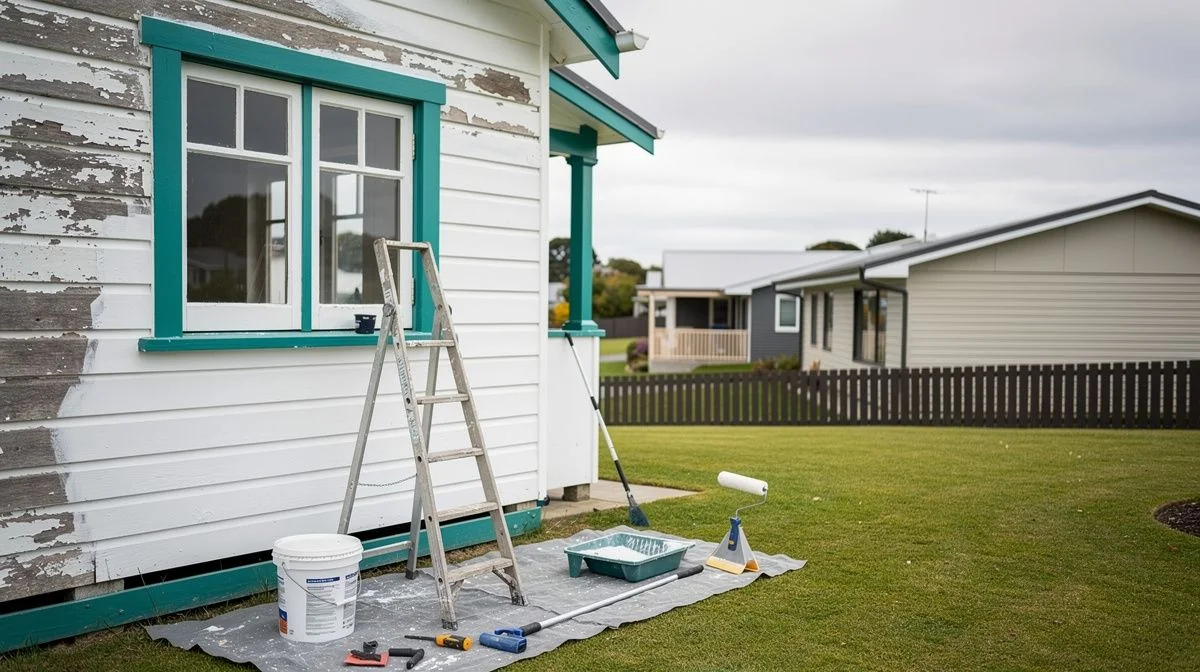
Two houses of the same size can be quoted 80 per cent apart, and the difference is rarely the paint. It is how much preparation the surface needs. Sound weatherboards that are washed, sanded and spot-primed sit at the bottom of the range; boards carrying flaking or heavily built-up coatings that must be stripped back to bare timber sit at the top.
This divide runs through Porirua. In the older suburbs, preparation dominates the bill, and it is where every shortcut shows up later. In newer subdivisions, there is very little to prepare — the coating is intact, the boards are sound, and the work is mostly about finish quality, cutting in, and coverage.
Cheap quotes cut preparation because none of it is visible once the job is finished. On an older home, that means another failure within a few winters, which is precisely the cycle these houses have already been through at least once.
Porirua Factors That Change the Job
Older State Housing and Full Preparation
The established eastern and southern suburbs hold a large stock of modest timber homes, many originally built as state housing. They are well built but often carry several generations of paint, and the coatings frequently fail together rather than gradually. A proper job means stripping back to sound timber, sealing joints, repairing rot and priming bare areas.
Newer Subdivisions and Interior-Only Work: Newer growth areas are full of homes that don't yet need exterior repainting. For those owners, the job is almost entirely interior: plasterboard walls and ceilings at $20–$30 per m², trims at $12–$22 per lineal metre, and doors at $320–$420 each. Timing an interior repaint before settlement or between tenancies is often the sensible move.
Different Suburbs, Different Decisions
Aotea and Waitangirua present very different painting jobs, and the right approach differs accordingly. In the newer growth areas, a properly documented exterior repaint keeps a recent home in good order. In the older suburbs, staged work and prioritising the worst elevations is usually the practical approach.
Rentals and a Younger Population
Porirua has a younger, more diverse population than the capital, and the rental market is active. It also has substantial Māori and Pasifika communities with strong local roots. Landlords repainting between tenancies should include mould treatment and stain-blocking, because a hard-wearing interior in a family home takes more punishment than a single professional's flat.
Access After Transmission Gully
Transmission Gully has changed travel times around the region, and improved access makes it easier for painters from across Wellington to quote here. That also means quotes come from firms with no local track record, so ask where the business is based.
How to Choose a Painter in Porirua
Match the painter to the job. If you own an older state house with failing exterior paint, you need someone experienced in stripping, rot repair and sealing. If you own a recent build, the questions are about finish quality, coverage and cutting in.
Either way, ask for the scope in writing, the number of coats and the products by name. Ask for two references from homes similar in age and cladding to yours, and check whether the firm has worked in your part of the city before.
Warning Signs
- Painting over flaking coating without stripping back to sound timber.
- No rot repair allowance on an older timber home.
- A painter with only new-build experience quoting a full exterior strip.
- No preparation detail, only a total.
- A price far below the bands above with no exclusions explained.
- No written scope and no product names.
Reading a Quote Without Getting Burned
Ask for the scope in writing: rooms or elevations, preparation method, rot repairs, number of coats, product names, access and a start date. On an older home, the preparation and repair lines are the substance of the quote, not the paint.
Confirm whether GST is included, because 15% turns $10,000 into $11,50,0 and painting quotes are commonly given before GST. Confirm the exclusions too: rotten board replacement, putty repairs, plaster patching and waste disposal are all frequent extras.
Questions You Might Have
My house is new. Do I need an exterior repaint yet?
Usually not. Most recent builds will not need exterior coating work for some years. For most owners in the newer subdivisions, the sensible spend is interior: plasterboard walls and ceilings, trims and doors, done properly with a written scope.
How do I budget for an older state house exterior?
Expect the upper end of the exterior bands unless the coating is sound. If the paint is flaking in sheets, budget for full stripping at $105–$145 per m² of façade, plus a repair allowance for rotten boards.
Can I stage the work over a couple of seasons?
Yes. Doing the exposed elevations first and the sheltered ones later is a reasonable approach as long as the painter records the products used so the next stage matches. It also spreads the cost across two seasons and lets you judge the finish before committing to the rest.
Does it matter if the painter is local?
Local knowledge helps with exposure and access, but experience with your type of house matters most. A firm from elsewhere with a strong record on older weatherboard homes is a better choice than a local firm that only does new builds.
What Matters Most
Porirua is not one market, and neither is its painting. Older homes in the established suburbs need preparation above all: stripping, sealing, rot repair and priming, with the gap between a sound weatherboard at $60–$80 per m² and one needing full stripping at $105–$145 per m² sitting entirely in that surface work. Newer homes need almost none of it and should spend on interior finishes instead.
Work out which house you own before you compare prices, get the scope in writing, and do not let a low total talk you out of the preparation an older home needs. To compare firms across the city, see our painters directory.

The ValueHub Team built this site because finding clear, unbiased financial information in New Zealand was harder than it should be. Every guide is based on real research — we compare the actual fees, terms, and fine print so you don't have to. Our tip: shop around every year, read the policy docs, and never assume loyalty gets you the best deal.— The ValueHub Team
Try our Calculators
Use these free tools to crunch the numbers:
KiwiSaver Fund Comparison
Compare fees, returns, and risk levels across every KiwiSaver fund — the most up to date data in New Zealand.
Currency Converter — USD to NZD
Convert US Dollars to New Zealand Dollars instantly. See the latest exchange rate and 30-day trend.
Mortgage Repayment Calculator
Calculate your weekly, fortnightly, or monthly mortgage repayments. Free NZ mortgage calculator — try different rates, terms, and repayment frequencies.
Compound Interest Calculator
See how your savings grow with compound interest over time. Free NZ compound interest calculator with yearly, monthly, and weekly compounding options.
Term Deposit Calculator
Calculate your term deposit returns before you lock in. Compare interest earned across different terms and rates with ValueHub's free calculator.
Savings Goal Calculator
Calculate how long it will take to reach your savings goal — and what monthly deposit you need to get there. Free NZ savings planner.
Painters in Other Cities
Latest Guides & Reviews
KiwiSaver and Tax — PIR, ESCT and What You Actually Pay
KiwiSaver is taxed twice — ESCT on your employer's contribution and your PIR on the fund's returns. How each rate is set, and the two most members never check.
reviewInvestNow KiwiSaver Scheme Review
InvestNow KiwiSaver review: 45 open funds, fund charges from 0.03 to 1.38 per cent, and net returns to 30 June 2026.
reviewKernel KiwiSaver Scheme Review
Kernel KiwiSaver review: 25 open funds, fund charges from 0.25 to 0.45 per cent, and net returns to 30 June 2026.
guideTax Debt in New Zealand — The Numbers
Official figures on New Zealand's overdue tax debt: the total, the collectable share, which customer groups hold it, and how much is repaid or written off.