Best Painters in Wellington
Published 11 September 2026 · Written by the ValueHub team · Reviewed by Steve Baron
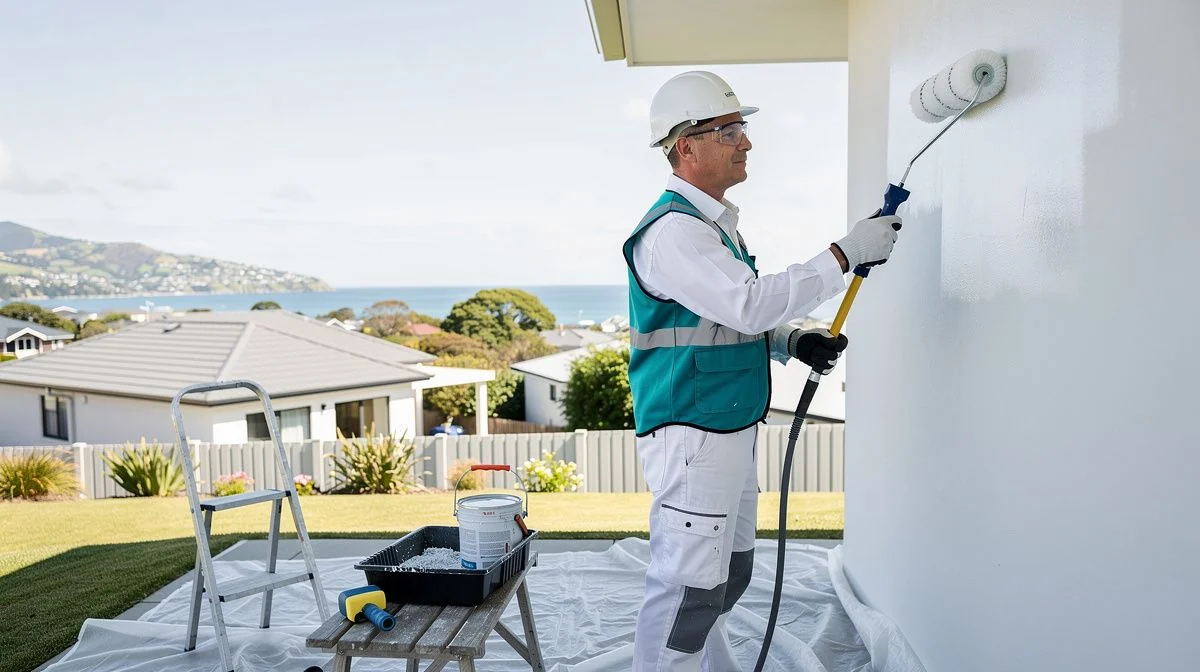
Why Wellington Exteriors Take a Beating
Wellington's weather is the first line in any painting quote here. Wind-driven rain pushes water sideways into joints, laps and window reveals that stay dry in other cities, and salt carried off the harbour and the south coast settles on every exposed wall. Paint that looks sound on a calm day can be hiding moisture behind it.
The terrain is the second. A large share of the city's housing sits on hillsides, in narrow streets and on stepped sections, which affects access as much as it affects the coating. A job needing scaffolding, edge protection and careful masking on a steep site costs materially more than the same house on flat ground. That access cost is why owners here weigh a full repaint carefully, whether they intend to stay or to sell.
How We Researched This Guide
We worked from current New Zealand painter pricing guides and published trade cost data, then checked the ranges against how quotes are actually structured: labour and preparation, materials, access and GST.
For local context, we looked at how quotes are built for Wellington's hillside and coastal homes, where access and exposure change the work. Where a source gives a range, we give the range, and we limit specific figures to what we could verify. Prices move with labour and materials, so treat every figure as the start of a conversation.
Our Trusted Painters
We feature businesses that demonstrate strong performance, proven experience, and consistently positive customer feedback. Some of the providers listed may have commercial relationships with us, but all are selected based on quality and reliability.
To begin, reach out to them and speak with them directly — this helps you explain your job, ask questions, and confirm whether they're the right fit.
Looking for House Painters in Wellington & Porirua? Your search ends with Viet Duc Ltd. Call our experienced interior and exterior house painters to schedule a consultation.
The 60-Second Version
If you read only one section, read this.
- Preparation, not paint, is the biggest single driver of what you pay.
- Sound timber weatherboards sit around $60–$80 per m²; boards needing full stripping run $105–$145 per m².
- Plaster and roughcast claddings cost up to 20 per cent more, because they need extra primer and filling.
- Two-storey exteriors cost far more than single-storey, mostly because of scaffolding.
- A whole three-bedroom interior repaint typically lands between $8,000 and $12,500.
- The cheapest quote is usually the one that has cut preparation, and preparation is what fails first.
What Painting Costs in Wellington
Rates are quoted either per square metre of floor area for interiors or per square metre of façade for exteriors. Knowing which measure a quote uses is what makes two numbers comparable.
| Work | Typical cost |
|---|---|
| Interior repaint | $35–$55 per m² of floor area |
| Interior including walls, ceilings and trims | $60–$85 per m² |
| Exterior basic finish | $45–$65 per m² of façade |
| Exterior premium finish | $65–$95 per m² of façade |
| Timber weatherboards in sound condition | $60–$80 per m² |
| Weatherboards needing full stripping | $105–$145 per m² |
| Smooth plaster cladding | $32–$48 per m² |
| Medium-textured plaster | $40–$60 per m² |
| Rough-textured plaster | $58–$80 per m² |
| Interior plasterboard walls and ceilings | $20–$30 per m² |
| Skirtings and window or door liners | $12–$22 per linear metre |
| Standard interior door | $320–$420 each |
Ranges drawn from published New Zealand painter pricing guides and trade cost data. Quotes vary with access, cladding condition and whether GST is included.
What a Whole House Costs
Most people want a total rather than a rate. A three-bedroom interior repaint commonly runs $8,000–$12,500. A single-storey exterior usually costs $8,500–$15,000, and a two-storey exterior costs $15,000–$22,000. Roof painting is a separate line at roughly $5,000–$11,000—a full repaint of the interior, exterior, and roof lands between $25,000 and $45,000.
As a cross-check, multiply the exterior façade area by $70–$140 per m² (depending on cladding), and the interior floor area by $35–$55 per m² for a straightforward repaint. If a quote sits well below those bands, the useful question is what has been left out.
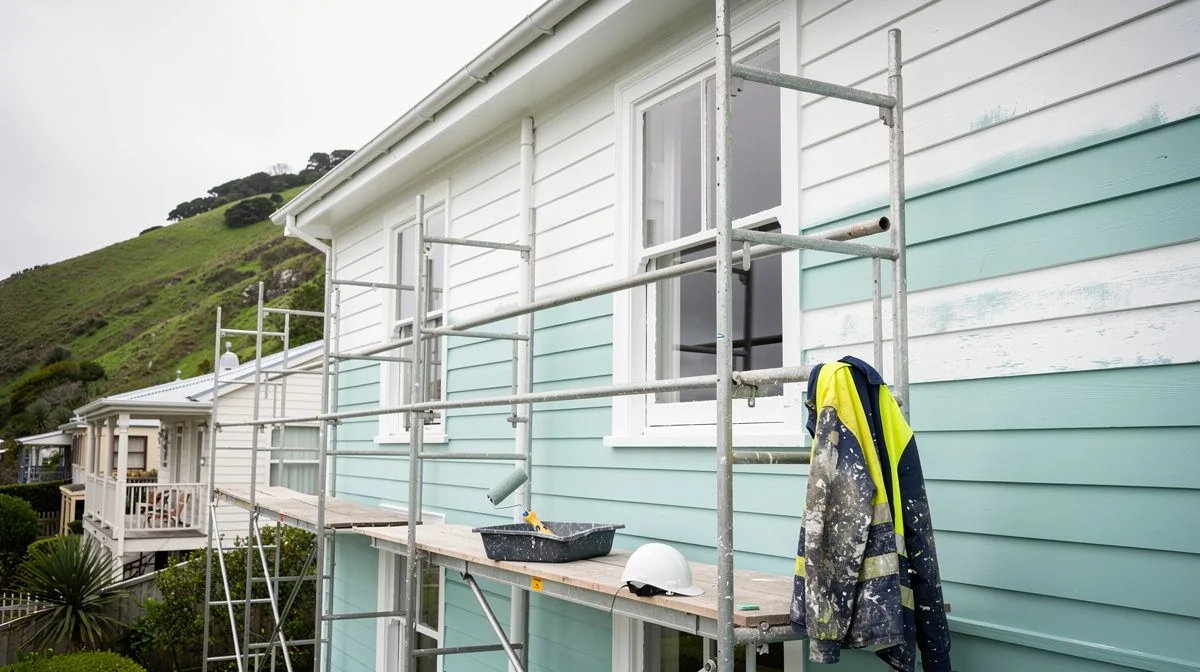
Preparation Is Where the Money Goes
Two weatherboard houses of the same size can be quoted 80 per cent apart, and the difference is rarely the paint. It is how much preparation the boards need. Sound boards that are washed, sanded, filled and spot-primed sit at the bottom of the range. Boards with flaking or built-up coatings that must be stripped back to bare timber sit at the top.
Wellington's climate widens that gap. Exterior coatings on the exposed side of a house fail sooner than on the sheltered side, and windward elevations usually need the most work.
Cheap quotes cut preparation because it is invisible. Stripping, sanding, filling, sealing and priming are all labour, all expensive and all hidden under the topcoats. When the coating fails two or three winters later, it fails at the joins and bare patches—exactly where the shortcut was taken.
Wellington Factors That Change the Job
Wind and Salt on Exposed Elevations
The windward walls, and anything facing the harbour or the south coast, take the worst of it. Salt residue has to be washed off before coating, or the new paint will not bond properly, and exposed joints and laps need attention because that is where wind-driven rain gets in.
Steep Sites and Difficult Access
Hillside sections and narrow streets limit where a ladder can safely stand. That pushes a job towards scaffolding, and scaffolding is a real cost line rather than a detail. Ask whether access is included, because a quote that assumes a ladder and hits a slope will be adjusted on day one.
Older Villas and Bungalows
The inner suburbs have many older timber homes with wide weatherboards, deep reveals, and detailed trim. They are the best surface to coat when they are sound, because timber accepts paint well. They are also the most expensive to bring back when the coating has been neglected.
Two-Storey Townhouses
The city's newer terraces and townhouses are usually two or three levels on tight sites, which multiplies exterior access costs while the interior stays straightforward. Budget the two separately rather than accepting one blended figure.
How to Choose a Painter in Wellington
Start with whether the firm can handle the access your property needs. Ask what scaffolding or edge protection they will use, who supplies it, and whether it's included in the quote. Then ask how they will prepare the surface, in their own words, because that answer tells you more than any price.
Ask for the number of coats, the products by name, and whether bare timber will get a specific primer. Ask what happens if weather stops work, and ask for two references from jobs of a similar age and cladding.
Warning Signs
- A quote with no preparation detail, only a total.
- Prices well below the bands above with no explanation of what is excluded.
- No mention of scaffolding on a two-storey or hillside home.
- Cash-only pricing with no written scope and no invoice.
- Pressure to start immediately, or a discount that expires the same day.
- No written record of which products will be used.
Reading a Quote Without Getting Burned
Ask for the scope in writing: rooms or elevations, preparation method, number of coats, product names, access arrangements and a start date. A one-line quote is not a quote.
Confirm whether GST is included. Fifteen per cent turns a $10,000 job into $11,500, and quotes in this trade are commonly given before GST. Confirm what is excluded as well: shifting furniture, replacing rotten boards, repairing failed putty, and disposing of paint waste are common extras.
Questions You Might Have
How long should a good exterior job last?
It depends more on preparation, the coating, and exposure than on the brand. A properly prepared job on a sheltered wall will far outlast a cheap job on a windward wall. Ask what the painter expects for your house and get the answer in writing.
Is it cheaper to paint in winter?
Painting through a Wellington winter is a gamble. Moisture and low temperatures affect how coatings cure, and wind-driven rain can undo a day's work.
Should I repaint before selling, or leave it?
Paint is one of the few pre-sale jobs that can pay for itself, because buyers read a well-maintained exterior as a well-maintained house. Even so, only spend if the return on your specific property is plausible.
Does a higher price always mean a better job?
No. Price tracks preparation and access, so a high quote with no explanation is no better than a low one. What matters is a written scope stating exactly what will be done and with which products.
What Matters Most
Painting is one of the few trades where the cheapest option is reliably the worst value. The gap between a sound weatherboard at $60–$80 per m² and one needing full stripping at $105–$145 per m² is entirely preparation, and preparation is what protects the cladding underneath.
In Wellington, wind, salt, steep sites, and older timber homes all push preparation costs up, which is why prices here tend to sit above the national bands—budget to do it properly once rather than cheaply twice. For comparisons across the region, see our painters directory.

The ValueHub Team built this site because finding clear, unbiased financial information in New Zealand was harder than it should be. Every guide is based on real research — we compare the actual fees, terms, and fine print so you don't have to. Our tip: shop around every year, read the policy docs, and never assume loyalty gets you the best deal.— The ValueHub Team
More Painters in Wellington
These businesses also operate in this area.
Red Owl Painters | Experienced residential house painters. Interior and exterior painters. Roof painters. Karori painters, servicing the Wellington region. Delivering a quality finish – with care and attention to detail throughout the entire painting process From the initial paint preparation though to undercoats and final top coats.
Wellington's trusted painting company for over 20 years. Residential & commercial painting, plastering, wallpapering and roof painting. Master Painters certified, Dulux Accredited. Free quotes. Hi, I’m Marc Waterworth Director and owner of Paradise Painting Services Limited.
Try our Calculators
Use these free tools to crunch the numbers:
KiwiSaver Fund Comparison
Compare fees, returns, and risk levels across every KiwiSaver fund — the most up to date data in New Zealand.
Currency Converter — USD to NZD
Convert US Dollars to New Zealand Dollars instantly. See the latest exchange rate and 30-day trend.
Mortgage Repayment Calculator
Calculate your weekly, fortnightly, or monthly mortgage repayments. Free NZ mortgage calculator — try different rates, terms, and repayment frequencies.
Compound Interest Calculator
See how your savings grow with compound interest over time. Free NZ compound interest calculator with yearly, monthly, and weekly compounding options.
Term Deposit Calculator
Calculate your term deposit returns before you lock in. Compare interest earned across different terms and rates with ValueHub's free calculator.
Savings Goal Calculator
Calculate how long it will take to reach your savings goal — and what monthly deposit you need to get there. Free NZ savings planner.
Painters in Other Cities
Latest Guides & Reviews
KiwiSaver and Tax — PIR, ESCT and What You Actually Pay
KiwiSaver is taxed twice — ESCT on your employer's contribution and your PIR on the fund's returns. How each rate is set, and the two most members never check.
reviewInvestNow KiwiSaver Scheme Review
InvestNow KiwiSaver review: 45 open funds, fund charges from 0.03 to 1.38 per cent, and net returns to 30 June 2026.
reviewKernel KiwiSaver Scheme Review
Kernel KiwiSaver review: 25 open funds, fund charges from 0.25 to 0.45 per cent, and net returns to 30 June 2026.
guideTax Debt in New Zealand — The Numbers
Official figures on New Zealand's overdue tax debt: the total, the collectable share, which customer groups hold it, and how much is repaid or written off.