Best Plumbers in Christchurch
Published 10 March 2025 · Updated 18 August 2026 · Written by the ValueHub team · Reviewed by Steve Baron

Why a Good Plumber Matters in Christchurch
New Zealand does have mandatory licensing for plumbers — unlike some trades, you cannot legally carry out sanitary plumbing, gasfitting, or drainlaying work without a current practising licence from the Plumbers, Gasfitters, and Drainlayers Board (PGDB). That is the good news. The bad news is that licensing establishes a floor, not a ceiling, and the gap between a plumber who meets the minimum legal standard and one who does consistently excellent work is wide.
Christchurch is a plumbing market unlike any other in New Zealand, and the reason sits literally beneath every house. The 2010–2011 Canterbury earthquake sequence reshaped not just the city's buildings but its entire approach to how plumbing and drainage must be designed. The Canterbury earthquakes fundamentally changed the regulatory framework. MBIE introduced Residential Technical Guidance for TC1, TC2, and TC3 land classifications, each with specific requirements for foundation design, and those requirements cascade directly into how plumbing services enter, exit, and run beneath every home.
Flexible connections, sleeved pipe penetrations through slabs, snaked service trenches — these are not add-ons in Christchurch. They are the difference between a plumbing system that survives the next significant earthquake and one that ruptures, floods your subfloor, and leaves you without water for weeks.
Beyond the earthquake legacy, Christchurch has a set of plumbing risks that exist nowhere else in the country. The city draws its water from an aquifer beneath the Canterbury Plains rather than surface catchments — the groundwater chemistry is fundamentally different from Auckland's Waikato River supply or Wellington's Hutt River supply. That groundwater, particularly from the shallow wells serving western and southern suburbs, has been linked to pitting corrosion in copper pipes and accelerated hot water cylinder failures for decades.
When the Council introduced temporary chlorination of the water supply in 2018, a University of Canterbury report confirmed that chlorine interacts with Christchurch's specific water chemistry to accelerate pitting corrosion in copper hot water cylinders. A plumber who works in Christchurch needs to understand which cylinder materials and pipe specifications are appropriate for which suburbs — one-size-fits-all advice from a national brand does not account for Christchurch's groundwater map.
A standard callout in Christchurch typically runs between $90 and $120 per hour during business hours, with a callout fee of roughly $80–$120 that often includes the first 30 minutes. After-hours emergency rates can push to $180–$300 per hour. Those fees are lower than Auckland or Wellington — Christchurch's cost base is lower, and competition among large post-quake rebuild companies has kept rates in check — but the cost of getting it wrong in Christchurch is not the bill.
It is a hot water cylinder that corrodes five years early because it was not rated for the local water chemistry, or a blocked drain on a TC3 property where excavation means disturbing a specifically engineered foundation, or a gas pipe that was not sleeved through the slab and snaps at the penetration point during the next significant shake. A good Christchurch plumber does not just fix what is broken — they understand why it broke and whether the rest of the system is heading the same way.
How We Researched This Guide
We reviewed the PGDB public register to confirm licence types and requirements, read the Plumbers, Gasfitters, and Drainlayers Act 2006, and checked Master Plumbers membership standards. For Christchurch-specific content, we reviewed MBIE's Canterbury Residential Technical Guidance (Parts A, B, and C), the Christchurch City Council Technical Categories Map, CCC's Water Services Bylaw, the University of Canterbury report on chlorine-related pitting corrosion, and the Council's Backflow Prevention Policy.
We also visited websites of Christchurch plumbing companies to understand local pricing structures, looked at GNS Science liquefaction susceptibility mapping for the Canterbury region, and cross-checked with industry cost guides to verify the pricing data in our tables.
Our Trusted Plumbers
We feature businesses that demonstrate strong performance, proven experience, and consistently positive customer feedback. Some of the providers listed may have commercial relationships with us, but all are selected based on quality and reliability.
To begin, reach out to them and speak with them directly — this helps you explain your job, ask questions, and confirm whether they're the right fit.
The experts in Plumbing & Electrical. When you hire a Laser Plumber or Electrician, you'll receive our 'Totally Dependable' service! Timely delivery, a promise of care and skill; appropriate work for customers' needs; well-presented, professional employees; responsibility for supplied materials, honouring manufacturer guarantees; and meeting and frequently exceeding our customers' expectations.
NZ Plumbing Licences — What Actually Matters
Plumbing is one of the most tightly regulated trades in New Zealand, and the licensing system is worth understanding before you pick up the phone. It is governed by the Plumbers, Gasfitters, and Drainlayers Act 2006 and enforced by the PGDB.
| Licence Type | What It Allows |
|---|---|
| Certifying Plumber | The highest level. Has completed the NZ Certificate in Plumbing (Level 4), held a practising licence for at least 24 months, and passed the certifying examination. Can supervise other plumbers and certify their own work. This is the licence you want for anything beyond basic maintenance. |
| Registered Plumber (non-certifying) | Has completed the Level 4 qualification but not yet the certifying exam (or has chosen not to sit it). Can do plumbing work but must operate under a certifying plumber's supervision. Many experienced plumbers sit here — the work is legally compliant, but they cannot certify it themselves. |
| Limited Certificate (trainee/apprentice) | Issued to people actively completing their Level 4 apprenticeship. Must work under direct supervision of a certifying plumber. Their authorisation is specific — they can do the work their training covers and nothing else. |
Certifying Gasfitter and Certifying Drainlayer are separate licences issued by the same Board. Many plumbers hold multiple — a plumber who is also a certifying gasfitter can handle your hot water cylinder swap, gas cooktop installation, and issue the legally required Gas Safety Certificate all in the same visit. In Christchurch, where gas installations must comply with AS/NZS 5601.1 and the Gas (Safety and Measurement) Regulations 2010 — and where flexible connections for seismic resilience are a specific Canterbury requirement — having both licences on the same professional is particularly valuable.
Annual CPD is mandatory. Every licensed plumber must complete continuing professional development each year to renew their practising licence. You can verify any plumber's current licence status, licence type, and disciplinary history on the PGDB public register at pgdb.co.nz — it takes 30 seconds, and it is free.
Master Plumbers — the industry body, not a regulator. Master Plumbers is a membership organisation. To join, a business must employ a certifying plumber, gasfitter, or drainlayer who has been running their own business for at least six months. Members go through a quality assurance process — an interview and a business review — and must adhere to a code of conduct.
The key consumer protection is the 12-month residential Master Plumbers Guarantee, which covers up to $20,000 for substandard workmanship and protects advance payments if the contractor goes into liquidation. Master Plumbers members must also hold public liability insurance. It is a useful quality signal, but it is not a government licence — plenty of excellent non-member plumbers do outstanding work.
Christchurch Plumbing Pricing — What You Can Expect to Pay
Christchurch plumbing rates sit slightly below Auckland and Wellington, reflecting lower operating costs and a competitive market shaped by the large post-quake rebuild workforce. The city's flat terrain also means fewer access challenges than Wellington's hillside homes, though sprawling suburbs like Halswell, Rolleston, and Rangiora mean travel distances can add to callout costs. The figures below are for standard business hours (generally Monday to Friday, 7 am to 5 pm). After-hours, weekend, and public holiday rates are significantly higher.
| Job | Typical Price Range (ex GST unless stated) |
|---|---|
| Standard callout (first hour) | $80–$280 |
| Hourly rate (after first hour) | $90–$120 |
| After-hours emergency callout (first hour) | $180–$300 |
| Tap washer or cartridge replacement | $120–$300 |
| Blocked drain (high-pressure jetting) | $200–$500 |
| Toilet replacement (supply + install) | $600–$1,100 |
| Electric hot water cylinder replacement (like-for-like) | $2,000–$4,500 |
| Gas continuous flow hot water system (supply + install) | $2,500–$5,500 |
| Hot water heat pump (supply + install) | $6,000–$9,500 |
| Gas cooktop installation | $300–$600 |
| Gas compliance certificate (standalone) | $150–$350 |
| Full house replumb (standard 3BR) | $7,000–$18,000 |
| CCTV drain inspection | $200–$500 |
| Underfloor plumbing inspection (post-quake compliance) | $150–$350 |
Price ranges verified from multiple Christchurch plumbing provider websites, industry cost guides, and pricing platforms as of August 2026. Final quotes depend on property access, job complexity, materials required, foundation type (TC classification), and whether the work falls within standard business hours.
What drives the price. The biggest variable in Christchurch is the property's Technical Category. A simple tap washer replacement in a TC1 home in Burnside is straightforward. A hot water cylinder replacement in a TC3 home in Bexley or the eastern suburbs, where the foundation may be a specifically engineered raft slab, means the plumber needs to understand the foundation system before cutting into any floor coverings or drilling into walls.
Concrete slab-on-ground foundations — common in post-quake rebuilds — make underfloor access impossible without cutting into the slab, which is a significant job in itself. By contrast, many older Christchurch homes in TC1 and TC2 areas sit on piles with accessible subfloor space, making pipework relatively straightforward to access.
Water cylinder material matters. In Christchurch's western and southern suburbs — including Cashmere, Hoon Hay, Somerfield, Spreydon, and parts of Halswell — the groundwater chemistry has been linked to pitting corrosion in copper hot water cylinders for decades, predating even the chlorination issue.
When replacing a cylinder in these areas, a good plumber will recommend a cylinder with a thicker copper gauge or a cylinder specifically rated for areas with known pitting corrosion risk. The upfront cost difference is typically $200–$400 on a $2,000–$4,500 replacement — a fraction of the cost of repeating the job five years early.
Fixed price versus hourly. Some Christchurch plumbers quote fixed prices for common jobs (hot water cylinder replacements, toilet installs, gas cooktop connections). Others charge time and materials. A fixed-price quote gives you certainty — the price is the price regardless of how long the job takes. An hourly rate can work in your favour for small, straightforward tasks but carries open-ended risk for more complex work.
In Christchurch, where what is beneath the floor or behind the wall is often non-standard — original 1950s pipework, quake-damaged drains that were patched rather than replaced, or post-quake pipe connections that were never documented — a fixed price from an experienced local plumber who knows the suburb's specific history is worth the premium.
GST is usually additional. Most plumbing quotes exclude GST. A $3,500 hot water cylinder replacement is actually $4,025 including GST. Check whether the quote is GST-inclusive or exclusive before comparing prices.
How to Choose a Plumber — What Actually Matters
Licensing gets a plumber through the door legally. Beyond that, what separates a plumber you would call again from one you would not comes down to a few specific things — and in Christchurch, post-quake technical knowledge is the one that matters most.
Check their licence — actually check it
The PGDB public register at pgdb.co.nz lets you verify a plumber's current licence status, licence type, and any disciplinary history in 30 seconds. You need their licence number or full name. Look for a certifying licence (not just a limited certificate), confirm the licence is current (not expired), and check for any disciplinary action. If a plumber hesitates to give you their licence number, that tells you everything you need to know.
Experience with Christchurch's Technical Categories
This is the Christchurch-specific question that matters most. After the earthquakes, the city was divided into three Technical Categories — TC1 (liquefaction unlikely, standard foundations), TC2 (liquefaction possible, enhanced foundations), and TC3 (liquefaction possible, site-specific engineering design required). The MBIE Canterbury Residential Technical Guidance sets specific requirements for how plumbing services must be installed based on the property's TC classification.
A plumber who works in Christchurch should know — without you having to explain — that plumbing services on TC3 properties must enter the building at well-defined locations through flexible connections, that pipework sleeved through slabs requires a minimum 60mm clearance filled with foamed urethane, that services must not impede the foundation's ability to move laterally (particularly where slip layers are provided under surface slabs), and that plumbing should be located near outside walls for repairability.
They should also know that TC3 properties require site-specific engineering design — and that any plumbing work that disturbs the foundation or its drainage must be consistent with the property's geotechnical report. A plumber who looks blank when you mention TC classification or flexible slab penetrations is not the plumber you want working on your home.
You can look up your property's Technical Category on the Christchurch City Council website — the TC map is publicly available at ccc.govt.nz. Know your classification before you call a plumber.
Knowledge of Christchurch's groundwater chemistry
Christchurch draws its water from underground aquifers, not surface catchments. The water chemistry varies by suburb because different wells draw from different aquifer layers. Shallow wells serving western and southern suburbs (Cashmere, Hoon Hay, Somerfield, Spreydon, Halswell, Beckenham) have historically produced water with lower pH levels, which has been linked to pitting corrosion in copper plumbing for decades.
The Council's 2018 introduction of chlorination — and the University of Canterbury report that followed — confirmed that chlorine interacts with Christchurch's specific groundwater composition to accelerate corrosion in copper hot water cylinders. A good Christchurch plumber knows which suburbs this affects and recommends the appropriate cylinder material and grade accordingly.
A national-brand plumber who treats Christchurch water the same as Auckland or Wellington water will sell you a cylinder that costs more to replace, sooner.
Whether they do both plumbing and gasfitting
Many Christchurch plumbing companies also hold gasfitting licences. If you need a gas cooktop installed, a gas hot water system replaced, or a Gas Safety Certificate for a property sale, a plumber who holds both licences means one callout instead of two. In Christchurch, where gas installations must comply with AS/NZS 5601.1 and flexible connections are a specific Canterbury requirement, this dual-licence combination is even more valuable.
Emergency availability
A burst pipe at 2 am in a Christchurch winter, when the temperature outside is close to freezing, and you cannot turn the water off because the mains toby is somewhere under the garden that the last owner never documented, does not wait until Monday morning. Ask what the plumber's after-hours policy is before you need it. Some companies offer genuine 24/7 emergency response.
Others have an answering service that takes a message and calls back the next morning. The price difference on the actual callout is steep — $180–$300 per hour versus the standard $90–$120 — but knowing who to call and that they will actually come is worth more than saving $150 on an emergency rate you hope you never need.
Insurance and guarantees
Every reputable plumbing company carries public liability insurance. Ask to see the certificate. Master Plumbers members offer the $20,000 residential guarantee as an additional layer. Even if a plumber is not a Master Plumbers member, they should stand behind their work with a written workmanship warranty — at minimum 12 months on new installations. A plumber who will not put a warranty in writing is one you should not hire.
Red flags
- They will not give you their licence number. Walk away. This is not optional — verifying their licence takes you 30 seconds on the PGDB website.
- They quote a price over the phone without seeing the job. A blocked drain might be a simple hair clog or a collapsed earthenware pipe in a post-quake area where the ground has settled unevenly. Unless it is a genuinely straightforward job (replacing a known hot water cylinder model like-for-like), a plumber who quotes sight-unseen is guessing.
- They cannot or will not provide a written quote. Verbal estimates are not quotes. If the plumber will not put numbers on paper, assume the final bill will be higher than what they told you on the phone.
- They do not know what Technical Categories are or say they "do not matter for plumbing." MBIE's Canterbury Residential Technical Guidance explicitly requires flexible connections, sleeved slab penetrations, and specific installation methods based on TC classification. A plumber who does not know this is not compliant with post-quake Canterbury standards.
- They do not issue a Gas Safety Certificate after gas work. This is a legal requirement under the Gas (Safety and Measurement) Regulations 2010. A gasfitter who does not issue a certificate is breaking the law, and your insurance may be void if something goes wrong.
- They recommend the cheapest cylinder without asking which suburb you are in. In Christchurch's western and southern suburbs, you need a cylinder rated for groundwater with known corrosion risk. The cheapest option will cost you more in the long run.
What to Expect When You Call a Plumber
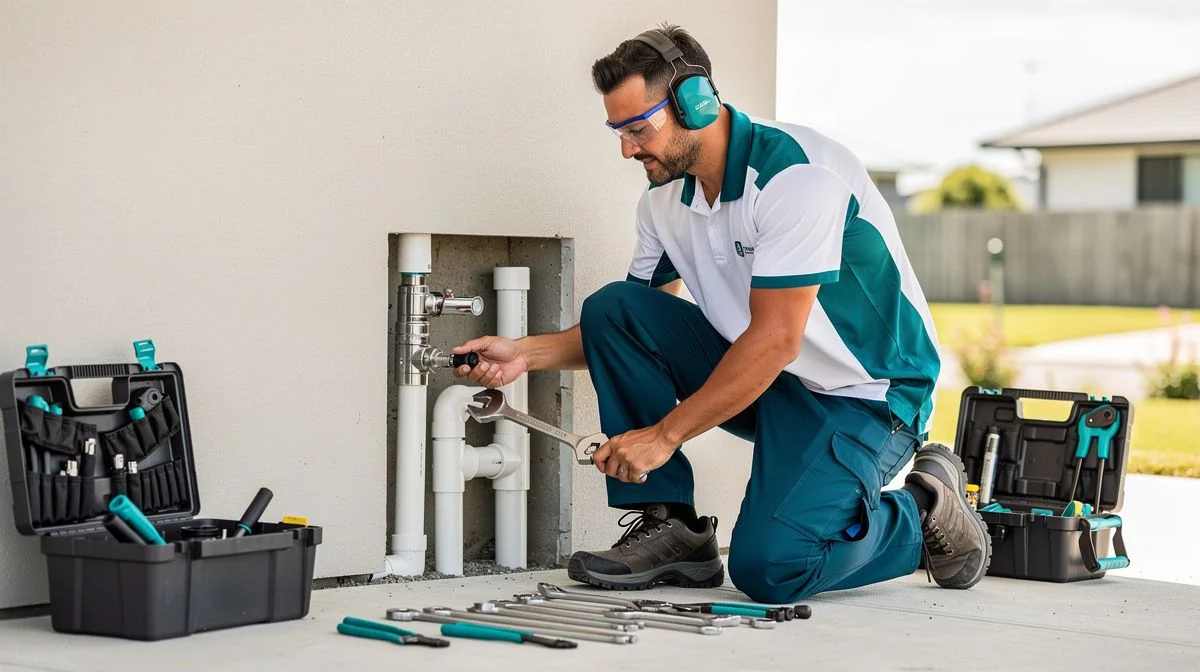
Before they arrive. When you call to book, describe the problem as clearly as you can. If it is a leak, say where it is coming from, how fast the water is running, and whether you have turned the water off at the mains toby. If it is a blocked drain, say which drain is blocked and whether multiple fixtures are affected. For Christchurch homes, mention your property's Technical Category if you know it — a plumber who arrives knowing they are working on a TC3 property with a specifically engineered foundation will bring different tools and take different precautions than one who arrives expecting a standard TC1 slab. Also mention anything unusual about your plumbing history — if the house was rebuilt after the earthquakes, if the drains were repaired rather than replaced as part of an EQC settlement, or if previous owners did unconsented plumbing work during the rebuild chaos.
When they arrive. The plumber assesses the situation, explains what they have found, and gives you a price before starting — either a fixed quote for the job or an estimate with a clear explanation of what could push the cost higher. For simple jobs (tap washer replacement, toilet cistern repair, basic drain clearing), they will usually get straight into it. For larger jobs (hot water cylinder replacement, gas appliance installation, major drain repairs), they may need to assess and return with parts, or quote and book a separate installation day. In Christchurch, be prepared for the plumber to find something unexpected — quake-damaged drains that were patched rather than replaced, hot water cylinder corrosion that is more advanced than the cylinder's age suggests, or pipe penetrations through the slab that were never sleeved when the house was rebuilt.
How long common jobs take.
- Tap washer or cartridge replacement: 20–45 minutes
- Blocked drain (jetting or electric eel): 30 minutes to 2 hours depending on access and root severity
- Toilet replacement: 2–4 hours including removal, new pan installation, and testing
- Electric hot water cylinder swap (like-for-like): 3–5 hours including draining, removal, installation, and refill
- Gas continuous flow unit installation: 4–8 hours depending on whether new gas pipe runs and flexible connections are needed
- Full house replumb: 3–10 days depending on house size, access, and whether you are living in the house during the work
- CCTV drain inspection: 45–90 minutes depending on drain layout complexity
After the job. The plumber tests their work, cleans up, and explains what they did. If the job involved gas work, they must issue a Gas Safety Certificate (confirming the installation is safe to use). If the work required a building consent — which some major plumbing alterations on TC3 properties do — they should also issue a Record of Work. Keep all certificates — you will need them if you ever sell the property, and Christchurch solicitors are now particularly rigorous about gas and drainage documentation given the city's post-quake history.
Christchurch-Specific Risks — What Your Plumber Should Know
Technical Categories — TC1, TC2, TC3 and what they mean for plumbing
This is the defining plumbing consideration in Christchurch, and it is one many homeowners do not even know about. After the 2010–2011 earthquakes, the city was divided into three Technical Categories based on observed land damage, soil conditions, groundwater levels, and liquefaction susceptibility:
- TC1 (grey on the Council map): Future land damage from liquefaction is unlikely. Standard residential foundation assessment and construction is appropriate. Plumbing work on TC1 properties follows standard NZ practice — no special seismic provisions required.
- TC2 (yellow): Liquefaction damage is possible in future large earthquakes. Shallow geotechnical investigations may be required when repairing or replacing foundations. Enhanced slab or suspended floor options apply. Plumbing installations must accommodate potential ground movement — flexible connections at the foundation boundary are required, though not to the same engineered specification as TC3.
- TC3 (blue): Liquefaction damage is possible in future large earthquakes, and sub-surface conditions make it uncertain whether TC2 foundations will perform adequately. Site-specific geotechnical investigation and foundation design by a Chartered Professional Engineer (CPEng) is required. The MBIE Guidance (Part C) sets specific plumbing requirements for TC3: services must enter at well-defined locations through flexible connections, pipework sleeved through slabs needs a minimum 60mm clearance filled with foamed urethane, services must not impede the foundation's lateral movement, and plumbing should be positioned near outside walls for future access and repair.
A plumber working on any Christchurch home should know the property's TC classification and what it means for their work. On a TC3 property, every decision that touches the foundation — drilling into a slab, cutting into floor coverings, excavating near the foundation edge, running new pipework under the floor — has regulatory implications that do not exist on a standard Auckland or Wellington property. A good Christchurch plumber checks the TC map before quoting major work and adjusts their approach accordingly.
Copper pinhole corrosion — a Christchurch-specific problem
Christchurch draws its water from underground aquifers, and the chemistry of groundwater varies significantly across the city. Shallow wells serving western and southern suburbs — Cashmere, Hoon Hay, Somerfield, Spreydon, Beckenham, Halswell, and parts of Riccarton — have historically produced water with lower pH levels, creating conditions where pitting corrosion can develop in copper pipes.
This is not a new problem — the Council was aware of pinhole failures in copper plumbing as far back as the 1990s, with failures typically occurring two to seven years after installation and concentrated almost entirely in the western and southern districts. Failures have been essentially unknown in northern and eastern suburbs served by deeper wells or different aquifer layers.
When the Council introduced temporary chlorination of the water supply in 2018 — a necessary public health measure following the Havelock North campylobacter outbreak — a University of Canterbury report confirmed that chlorine interacts with Christchurch's specific groundwater chemistry to accelerate pitting corrosion in copper hot water cylinders.
The report found that pitting corrosion was likely to become more frequently observed, though whether it extends to other copper plumbing fittings was yet to be determined. The Council's own public advice, published on its Newsline platform, explicitly recommends talking to your plumber about "specific cylinders that are sold for areas where pitting corrosion is prevalent" when replacing your hot water cylinder.
A plumber who works regularly in Christchurch should know which suburbs are affected and specify cylinders with thicker copper gauge or specific corrosion-resistant ratings for properties in those areas. They should also inspect accessible copper pipework for early signs of pitting — small green-blue spots on the pipe surface that indicate corrosion is underway beneath the patina. Catching pinhole corrosion early, before a pipe fails inside a wall cavity, is far cheaper than the alternative.
Dux Quest — still in Christchurch homes
Black polybutylene pipe installed in New Zealand homes between approximately 1978 and 1987, Dux Quest is widespread in Christchurch suburbs that saw construction during that era — including Bishopdale, Avonhead, parts of Halswell, and many 1980s subdivisions across the city.
The material chemically reacts with chlorine in the town water supply, becoming brittle from the inside out until hairline cracks form, joints fail at the acetal elbows, and the pipe eventually splits. Christchurch's specific groundwater chemistry, including the chlorination history, makes Dux Quest an even more urgent concern here than in most other NZ cities.
If your home was built or substantially renovated during the late 1970s to late 1980s and the plumbing has not been fully replaced, a plumber should flag it immediately during any inspection or repair visit. The standard professional recommendation is a full replumb, not spot repairs.
Fixing one burst section of Dux Quest simply moves the pressure to the next weakest point. Many insurers now limit coverage to the first Dux Quest leak or exclude claims entirely, and property sale agreements increasingly require disclosure.
Post-quake drain damage — the hidden legacy
The earthquake sequence did not just damage buildings. Underground drains — particularly older earthenware pipes — shifted, cracked, separated at joints, and in some cases collapsed entirely during the ground movement. EQC settlements covered drain repairs for many properties, but the quality of those repairs varies enormously — some drains were fully replaced, some were spot-repaired, and some were deemed "within tolerance" and left as-is despite partial cracking or slight misalignment that will worsen over time.
Compounding this, many Christchurch suburbs have experienced ongoing ground settlement since the earthquakes. A drain that was within tolerance in 2013 may now have joints that have separated further as the ground beneath it continues to compact. A CCTV drain inspection is worth doing on any Christchurch property where the drain history is unknown — it costs $200–$500 and shows you exactly what is happening underground.
If the property had EQC drain work done, try to locate the scope of works documentation — it will tell you what was repaired and what was assessed but left untouched. A plumber who reads the EQC drain scope before inspecting can target their check at the areas most likely to have deteriorated in the years since.
Rebuild-era plumbing — varying quality across thousands of homes
Between roughly 2012 and 2018, Christchurch rebuilt approximately 12,000 homes under immense time pressure. The volume of work was unprecedented — every plumbing company in the city was running at capacity for years, and workforce shortages meant companies brought in labour from other regions and overseas. The rebuild was largely successful, but the quality of individual installations varies.
Common issues a plumber may find in rebuild-era homes include: pipework penetrations through slabs that were not sleeved (or were sleeved without adequate clearance), gas pipe connections that are rigid rather than flexible (non-compliant with MBIE Guidance for TC2 and TC3), hot water cylinders installed without checking the local groundwater chemistry, and drainage connections that work fine day-to-day but would fail under the differential settlement that occurs during a significant earthquake.
A plumber inspecting a rebuild-era home should specifically check these points — none of them are visible to a standard building inspection, and none of them will cause problems until they do, which is usually at the worst possible time.
Shallow groundwater — the eastern suburbs challenge
Parts of eastern Christchurch — including Bexley, Aranui, parts of New Brighton, and the residential red zone fringe — have groundwater sitting within a metre of the surface. This creates several plumbing-specific challenges: underfloor pipework in older pile-foundation homes sits in a permanently damp environment that accelerates corrosion of metal fixings and fittings, stormwater drainage must contend with a water table that rises significantly after heavy rain, and excavation for new drain runs may require dewatering (pumping groundwater out of the trench during construction), which adds cost and complexity.
A plumber who works regularly in the eastern suburbs knows this and factors it into their approach — they specify corrosion-resistant fixings and fittings for underfloor work, they size stormwater drainage for higher-than-normal groundwater infiltration, and they do not quote a standard drain excavation price for a property where the trench will fill with water before they lay the pipe.
A plumber who does not know the difference between a Shirley drain job and a Cashmere drain job will underquote and either cut corners or hit you with a variation after the trench is open.
Backflow prevention — Christchurch City Council requirements
Under the Christchurch City Council Water Services Bylaw and Backflow Prevention Policy, property owners must prevent the reverse flow of water from private plumbing back into the public water supply. High and medium-risk properties (commercial buildings, multi-unit residential, properties with irrigation systems, swimming pools, fire sprinkler systems, or certain industrial activities) require a testable backflow prevention device at the property boundary.
These devices must be tested annually by a registered Independently Qualified Person (IQP), with test results submitted to the Council. Devices within the property boundary must be added to the Building Warrant of Fitness compliance schedule.
Christchurch's flat terrain and large suburban sections mean irrigation systems are more common here than in Wellington or Auckland — if your property has a garden irrigation system, a secondary water supply (e.g. a bore or rainwater tank plumbed into the house), or any equipment introducing chemicals into the water system, backflow prevention requirements likely apply.
A plumber working on any Christchurch property should check what backflow protection is in place and whether it complies with the Council bylaw.
Questions You Might Have
What should I do if a pipe bursts at night?
Turn the water off at the mains toby — in Christchurch, the toby is usually at the front boundary, often under a small green or black plastic cover flush with the lawn. In newer subdivisions like Wigram, Aidanfield, and Prestons, the toby cover is typically a hinged plastic lid in the grass strip between the footpath and the road. If you do not know where it is, find it now, before you need it.
Once the water is off, open the lowest tap in the house (usually an outside tap or laundry tub) to drain the remaining water. Then call an emergency plumber — expect to pay $180–$300 per hour rather than the standard $90–$120. If the burst is on the city side of the toby — between the street main and your boundary — contact Christchurch City Council, not a private plumber.
How do I know if my hot water cylinder is affected by the Christchurch water chemistry issue?
If you live in a western or southern suburb — Cashmere, Hoon Hay, Somerfield, Spreydon, Beckenham, Halswell, or surrounding areas — and your cylinder is copper, it is in the zone where pitting corrosion has been most commonly observed. Signs that corrosion is underway include: rusty or discoloured hot water (the cold tap runs clear but the hot tap runs brown — this indicates the cylinder lining is corroding), moisture at the base of the cylinder, running out of hot water faster than you used to, and a hot water cylinder older than 15 years.
A plumber can assess the cylinder's condition during a routine inspection. When the time comes to replace it, ask specifically for a cylinder with thicker copper gauge or one rated for areas with known pitting corrosion risk — the $200–$400 upfront cost difference is significantly less than replacing another cylinder in 5–7 years.
How do I find my property's Technical Category?
Go to ccc.govt.nz and search "Technical Categories Map." Enter your address and the map will tell you whether your property is TC1, TC2, or TC3. The map is free and publicly available. If your property is TC3, the Council website also links to the MBIE Guidance documents. When you call a plumber for anything beyond basic maintenance, tell them the TC classification upfront — it tells them what foundation type they are likely working with and which regulatory requirements apply.
Do I need a gas compliance certificate when selling my house?
Yes. If your property has any gas appliances or gas pipework, you will likely need a Gas Safety Certificate before settlement. Christchurch solicitors are particularly rigorous about this — the city's post-quake regulatory environment means gas documentation is scrutinised more closely here than in most other centres.
A standalone gas safety inspection and certificate typically costs $150–$350 depending on the number of gas appliances. If gas work was done during your ownership and no certificate was issued at the time, have the full system inspected and certified retrospectively. Do this well before settlement — discovering missing gas certificates a week before the buyer takes possession is avoidable stress.
Should I replace my hot water cylinder before it fails?
Hot water cylinders in New Zealand typically last 15 to 20 years, though Christchurch's groundwater chemistry may shorten that in certain suburbs. If your cylinder is approaching or past that age, replacing it pre-emptively is usually cheaper and far less disruptive than waiting for it to fail.
Signs a cylinder is nearing the end of its life include rusty or discoloured water, moisture or puddles around the base, running out of hot water faster, and rising power bills with no other explanation. If you are replacing an electric cylinder in a western or southern suburb, specify a corrosion-resistant model. If you are replacing it anywhere in Christchurch, consider a heat pump hot water system — the upfront cost is higher ($6,000–$9,500 versus $2,000–$4,500), but running costs are roughly a quarter of a standard cylinder, meaning most Christchurch households see payback in 4 to 7 years.
What if I am buying a house and the plumbing worries me?
A standard building inspection includes a visual plumbing check, but in Christchurch there are specific things worth following up with a dedicated plumbing inspection:
- Check the property's Technical Category on the Council map before the inspection — TC2 and TC3 properties have regulatory requirements that affect plumbing
- If the property is from the Dux Quest era (late 1970s to late 1980s), ask the plumber to specifically check for black polybutylene pipe in the ceiling and under the floor
- A CCTV drain inspection ($200–$500) is particularly valuable in Christchurch — it shows you exactly what happened to the underground drains during and after the earthquakes
- If the property was rebuilt or had EQC repairs after the earthquakes, ask the plumber to check flexible connections at foundation penetrations and whether the hot water cylinder is appropriate for the local groundwater chemistry
- If the property had EQC drain work, try to get a copy of the scope of works — it tells the plumber what was repaired and what was left as-is
- In eastern suburbs with high groundwater, check underfloor pipework for corrosion of metal fixings and fittings — the permanently damp subfloor environment accelerates wear
Do all Christchurch plumbers understand TC classifications?
Most experienced Christchurch plumbers who lived and worked through the rebuild do. However, plumbers new to the city, those from national franchises who rotate staff, and those who qualified in other regions may not. It is always worth asking the question directly — "what is my property's Technical Category and how does it affect your work?"
A plumber who can answer confidently and specifically about sleeved slab penetrations and flexible connections is one who understands Christchurch's post-quake regulatory environment. A plumber who looks confused or dismissive is not the right person for the job.
What Matters Most
Plumbing is not a trade where you should buy on price. The cheapest quote on a hot water cylinder installation or a drain repair often means corners were cut — a cylinder that was not rated for Christchurch's groundwater chemistry, a pipe penetration through a slab that was not sleeved for future ground movement, a drain repair that was patched rather than properly replaced, or a gas connection that is rigid where the MBIE Guidance requires it to be flexible.
In a city rebuilt after one of the most destructive earthquake sequences in New Zealand's history, where the ground beneath your house has been classified, mapped, and regulated down to the square metre, and where something as seemingly routine as the water coming out of your tap has different chemical properties depending on which side of Hagley Park you live on, a good plumber is not a luxury — they are the person who understands the complex intersection of geology, regulation, chemistry, and building science that determines whether your plumbing system will function reliably for 20 years or fail catastrophically in five.
Check the licence. Know your Technical Category. Ask about groundwater and cylinder materials in your specific suburb. Get the quote in writing. Keep every certificate. And if your home is from the 1980s and has never had its plumbing replaced, ask about Dux Quest — even if you called the plumber for something else entirely. A plumber who checks pipe materials during a routine job and tells you what they found is a plumber worth keeping.

The ValueHub Team built this site because finding clear, unbiased financial information in New Zealand was harder than it should be. Every guide is based on real research — we compare the actual fees, terms, and fine print so you don't have to. Our tip: shop around every year, read the policy docs, and never assume loyalty gets you the best deal.— The ValueHub Team
More Plumbers in Christchurch
These businesses also operate in this area.
ACF Plumbing offers reliable plumbing solutions. Learn more! Christchurch. Ready to embark on your plumbing journey with confidence. A black circle with a check mark inside of it on a white background. Prompt Emergency Responses Rapid, effective solutions for urgent issues. Rapid, effective solutions for urgent issues.
Laser Plumbing Christchurch East is your Totally Dependable plumbing contractor, offering plumbing services and quality workmanship across all of Christchurchs suburbs and surrounding areas. Our highly qualified and experienced plumbers provide complete and totally dependable plumbing services. You can depend on Laser Plumbing Christchurch East.
Try our Calculators
Use these free tools to crunch the numbers:
KiwiSaver Fund Comparison
Compare fees, returns, and risk levels across every KiwiSaver fund — the most up to date data in New Zealand.
Currency Converter — USD to NZD
Convert US Dollars to New Zealand Dollars instantly. See the latest exchange rate and 30-day trend.
Mortgage Repayment Calculator
Calculate your weekly, fortnightly, or monthly mortgage repayments. Free NZ mortgage calculator — try different rates, terms, and repayment frequencies.
Compound Interest Calculator
See how your savings grow with compound interest over time. Free NZ compound interest calculator with yearly, monthly, and weekly compounding options.
Term Deposit Calculator
Calculate your term deposit returns before you lock in. Compare interest earned across different terms and rates with ValueHub's free calculator.
Savings Goal Calculator
Calculate how long it will take to reach your savings goal — and what monthly deposit you need to get there. Free NZ savings planner.
Plumbers in Other Cities
Latest Guides & Reviews
KiwiSaver and Tax — PIR, ESCT and What You Actually Pay
KiwiSaver is taxed twice — ESCT on your employer's contribution and your PIR on the fund's returns. How each rate is set, and the two most members never check.
reviewInvestNow KiwiSaver Scheme Review
InvestNow KiwiSaver review: 45 open funds, fund charges from 0.03 to 1.38 per cent, and net returns to 30 June 2026.
reviewKernel KiwiSaver Scheme Review
Kernel KiwiSaver review: 25 open funds, fund charges from 0.25 to 0.45 per cent, and net returns to 30 June 2026.
guideTax Debt in New Zealand — The Numbers
Official figures on New Zealand's overdue tax debt: the total, the collectable share, which customer groups hold it, and how much is repaid or written off.