Best Computer Repair Technicians in Wanaka
Published 22 January 2025 · Updated 08 October 2026 · Written by the ValueHub team · Reviewed by Steve Baron
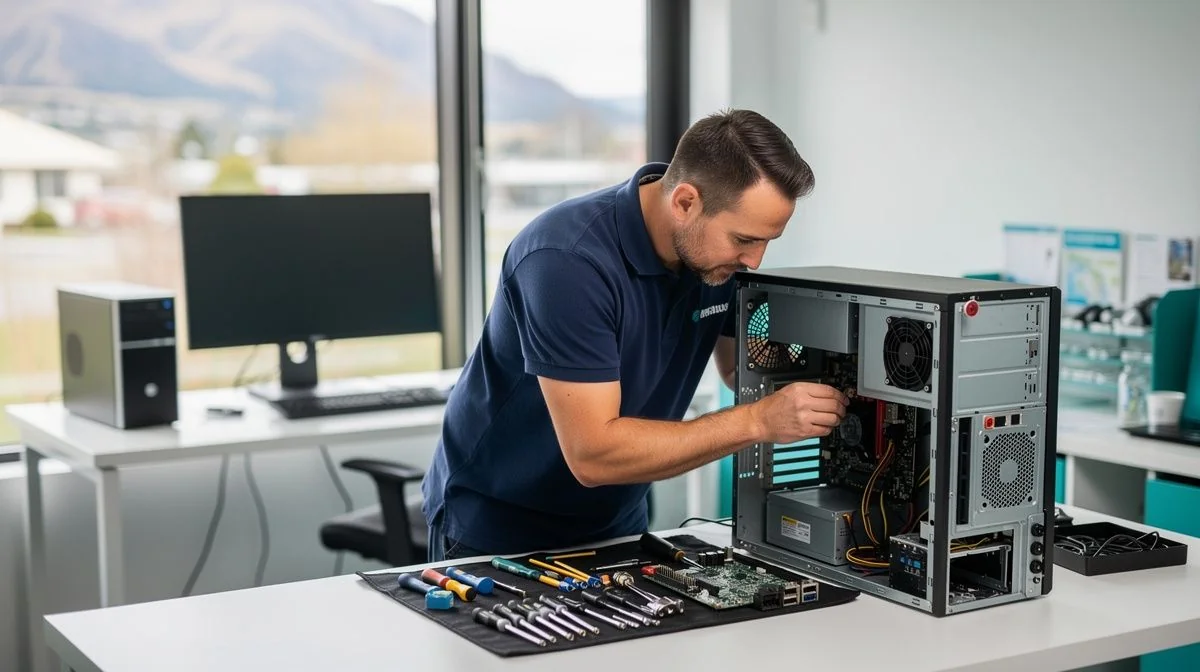
Best Computer Repair Technicians in Wanaka
The town is small, remote and busy, and the repair market reflects all three. A large share of the housing is holiday accommodation used for part of the year; there is a substantial seasonal workforce, and almost nothing in the way of parts is held locally, so nearly every repair involving a component begins with an order that has to travel.
The practical choice is usually between a local technician, a remote session for anything that is purely software-related, and couriering the machine to Queenstown, Dunedin, or Christchurch. We have set out the cost of each job and what to confirm before a machine leaves your hands.
How We Researched This Guide
We started with the rate cards repair firms publish for themselves, because a posted price is the only figure you can hold a technician to. Hourly labour sits within a fairly tight national band and varies very little, while fixed-price jobs, such as virus removal or screen replacement, vary widely, mostly because the parts differ.
We also looked at what happens to your data while the machine sits in someone else's workshop, which is why this guide includes the privacy questions to ask before handing over a laptop.
Our Trusted Computer Repair Technicians
We feature businesses that demonstrate strong performance, proven experience, and consistently positive customer feedback. Some of the providers listed may have commercial relationships with us, but all are selected based on quality and reliability.
To begin, reach out to them and speak with them directly — this helps you explain your job, ask questions, and confirm whether they're the right fit.
Built Around You - Custom PCs without compromise. Designed around your exact needs and carefully crafted using top-quality components for maximum performance, efficient cooling, high airflow, and long-term reliability.
The Quick Summary (60-Second Version)
If you want the short version before you ring anyone, this is it.
- Workshop labour runs $80 to $140 an hour, and most firms charge a minimum of 30 minutes or a flat first-hour fee.
- A diagnostic or assessment fee ranges from free to about $92. Ask whether it is waived if you go ahead with the repair.
- Virus and malware removal is usually a fixed price between $40 and $250, so ask for the fixed number rather than an hourly estimate.
- A laptop screen is the most expensive common repair at $260 to $450, and MacBook screens start around $500.
- Data recovery is quoted after an assessment, and a mechanical drive failure costs several times as much as a logical fault.
- Ask what happens to the copy of your files the technician takes before any reinstall. That is the question people forget.
What a Repair Actually Covers
A repair is a defined job, and the two factors that determine its cost are the fault and the part. Virus removal is labour-intensive and time-consuming. A cracked screen is a part plus labour. A failing drive is both, and it is the one job where the data matters more than the machine.
That is why the paperwork matters. Handing a machine over means handing over your email, your photos and whatever passwords the browser has saved, and the firm is responsible for them while it has the machine. The Office of the Privacy Commissioner publishes the applicable rules, and asking a firm what its own policy is tells you how seriously it takes them.
Ask too whether the work is covered by a written scope and what the warranty on the repair is. Consumer Protection publishes plain guidance on what a fair contract should tell you, and in this trade the useful questions are how long the warranty runs, whether the parts carry their own warranty, and what happens if the same fault returns.
How to Choose a Technician — What Actually Matters
Ask for a diagnosis before a price on anything expensive
A screen replacement or a drive failure cannot be quoted accurately without seeing the machine, and a firm that names a number before looking is guessing. A proper diagnostic answers one question: is this worth repairing at all?
Get the fixed price in writing, and ask what it excludes
Parts, courier costs for an ordered part, the software licence on a reinstall, and the labour of getting your files back before a wipe are the usual extras. None is unreasonable, but each turns an estimate into an invoice. A written scope that names them is the difference between the two.
Ask what happens to your data
Any repair that involves a reinstall should involve a backup first, and you are entitled to ask how that backup is handled, where it is kept and when it is deleted. A firm that answers this easily has thought about it; one that has not answers by changing the subject.
What Repairs Cost in Wanaka
Labour rates here sit at the upper end of the national bands, which is what a small remote market looks like: the technician's time is the same as anywhere, but the parts are not, and a business holding stock it may never use has to price for it. Travel is also a real line item if you are outside the town itself, so ask about it specifically.
The number that matters most here is turnaround rather than the hourly rate. A screen or a battery ordered from outside the region can take several days to arrive, and that delay costs a holiday home owner far more than the difference between two labour rates. Ask what is in stock before you decide who does the work.
| Job | Typical price |
|---|---|
| Workshop labour, per hour | $80–$140 |
| On-site or mobile labour, per hour | $95–$160 |
| Diagnostic or assessment fee | Free–$92 |
| Virus and malware removal, fixed price | $40–$250 |
| Windows reinstall or factory reset | $89–$180 |
| Data backup before a reinstall | $90–$99 |
| Laptop screen replacement, standard | $260–$350 |
| Touchscreen or 2-in-1 screen | $380–$420 |
| MacBook screen replacement | from $500 |
| Laptop keyboard replacement | $99–$170 |
| SSD or hard drive upgrade | from $199 |
| Data recovery, logical fault | $150–$375 |
| Data recovery, mechanical failure | $550–$675 |
Some firms quote including GST and others exclude it, so confirm the basis before comparing two quotes. Parts are extra on every job that includes a component.
Wanaka — What Changes Locally
Turnaround beats the hourly rate as the number that matters
In a town where almost nothing is held locally, the wait for a part is usually longer than the work itself. Ask two questions before you commit: is the part available in New Zealand, and what is the realistic delivery window? A firm that answers both questions plainly is worth more than one that quotes a lower hourly rate with no idea when the part will arrive.
Holiday homes produce the same faults every season
Property that is empty for months at a time generates a predictable set of problems: batteries that will not hold charge, drives that have failed quietly, and machines that will not update because they have been offline for a long stretch. If the machine only works while you are in town, a service before you leave is cheaper than a repair when you return.
Remote work covers more here than it does in a city
Because a call-out outside the town can mean a long drive, local technicians often prefer a remote session for anything software-related, and it is usually the right call. Virus removals, email problems, slow machines and printer setup can all be done that way, leaving only hardware faults for a workshop visit.

What Happens on a Repair Job
A properly run repair follows a set order, and knowing it tells you whether the whole job happened.
- The machine is assessed, and you are told what the fault is, whether it is worth repairing, and what the likely cost will be.
- You approve a written scope that names the parts, the labour, and anything the price does not cover.
- Your data is backed up before anything touches the operating system, and you are told where that copy goes and how long it is kept.
- The repair is carried out, and the machine is tested rather than simply switched on, including anything disturbed to reach the part.
- You get the machine back with the old part if it was replaced, and you are told what the warranty covers and for how long.
Questions You Might Have
Is it worth repairing an older laptop?
That depends on the machine's value, and an honest technician will tell you when the answer is no. A useful rule is that a repair costing more than roughly half of what a comparable replacement would cost is usually not worth doing, and a firm that says so is worth keeping rather than one that quotes regardless.
Can a repair be done remotely?
Software problems usually can be resolved remotely, and a remote session is cheaper because nothing has to be collected or delivered. Hardware cannot, so a cracked screen, a failing drive or a damaged charging port means the machine has to go to a workshop.
Will I lose my files?
Not in a normal repair, and a firm should be able to explain how it protects them. The repair that carries real risk is a reinstall, which is why a backup first is the standard step rather than an optional extra. If the drive itself has failed, the honest answer is that recovery is a separate job with its own price and no guarantee.
What Matters Most
Computer repair is based on two things: the diagnosis and the price. The diagnosis is what tells you whether to repair at all, and the fixed price is what stops a simple fault from becoming an open hourly bill.
Ask for the fault in plain language, get the job scoped in writing, and ask what happens to your files before anything is wiped. Those three answers separate a repair from a lesson.

The ValueHub Team built this site because finding clear, unbiased financial information in New Zealand was harder than it should be. Every guide is based on real research — we compare the actual fees, terms, and fine print so you don't have to. Our tip: shop around every year, read the policy docs, and never assume loyalty gets you the best deal.— The ValueHub Team
Try our Calculators
Use these free tools to crunch the numbers:
KiwiSaver Fund Comparison
Compare fees, returns, and risk levels across every KiwiSaver fund — the most up to date data in New Zealand.
Currency Converter — USD to NZD
Convert US Dollars to New Zealand Dollars instantly. See the latest exchange rate and 30-day trend.
Mortgage Repayment Calculator
Calculate your weekly, fortnightly, or monthly mortgage repayments. Free NZ mortgage calculator — try different rates, terms, and repayment frequencies.
Compound Interest Calculator
See how your savings grow with compound interest over time. Free NZ compound interest calculator with yearly, monthly, and weekly compounding options.
Term Deposit Calculator
Calculate your term deposit returns before you lock in. Compare interest earned across different terms and rates with ValueHub's free calculator.
Savings Goal Calculator
Calculate how long it will take to reach your savings goal — and what monthly deposit you need to get there. Free NZ savings planner.
Computer Repair Technicians in Other Cities
Latest Guides & Reviews
Kōura KiwiSaver Scheme Review
Kōura KiwiSaver review: 13 open funds, fund charges from 0.63 to 1.10 per cent, and net returns to 30 June 2026.
reviewMaritime KiwiSaver Scheme Review
Maritime KiwiSaver review: 3 open funds, fund charges from 0.61 to 0.76 per cent, and net returns to 31 March 2026.
reviewMAS KiwiSaver Scheme Review
MAS KiwiSaver review: 7 open funds, fund charges from 0.25 to 0.98 per cent, and net returns to 30 June 2026.
reviewArotahi KiwiSaver Scheme Review
Arotahi KiwiSaver review: 1 open fund, a 0.77 per cent fund charge, and net returns to 31 March 2026. What the Government register shows you pay and get back.