Best Landscapers in Dunedin
Published 29 January 2025 · Updated 18 August 2026 · Written by the ValueHub team · Reviewed by Steve Baron
Best Landscapers in Dunedin
Slope, clay and a growing season that starts late
Almost every landscaping conversation in Dunedin starts with the section rather than the planting. This is a city built over hills, and a great many back gardens fall away steeply towards a valley, a stream or a neighbour’s roof. That single fact decides whether a project is a planting job or a structure job, and it is why two quotes for what sounds like the same garden can be thousands of dollars apart.
The soil is the second local reality. Large parts of the city sit on heavy clay that holds water through winter and bakes hard in February, and the older suburbs carry the fill and rubble of a century of building. Roots struggle in both directions, which is why drainage and soil improvement often account for more of the budget than the plants.
The climate is cooler than the rest of the country and the growing season arrives later. Inland suburbs get proper frosts, the hill suburbs get wind, and the peninsula gets salt. A planting plan that would thrive in Nelson can sit still for two seasons here.
Then there is the consent side. Retaining walls above a certain height, earthworks on a slope, and work near a protected tree all attract council attention in a city as hilly and as heritage-conscious as this one.
How We Researched This Guide
We collected unit rates rather than project totals, because a total figure for “landscaping a section” is close to meaningless. The rates that actually hold up are per square metre for soft landscaping and paving, hourly rates for a landscape crew and for an excavator with an operator, and the tip fees that apply to soil and green waste. Those are the numbers a quote is built from, so they are the numbers we chased.
The ranges came from published New Zealand landscaping cost guides and from contractors who list their rates openly, and they were reasonably consistent apart from paving and retaining, where the spread reflects materials more than labour. We also read the official guidance on building work that needs consent, since retaining walls sit right on that line, and WorkSafe’s material on excavation, because a steep Dunedin section means digging near something that matters. Where a figure could not be sourced we left it out.
The 60-Second Version
The short version, before the detail.
- Landscape labour in Dunedin generally runs $65–$95 an hour, with a stonemason $90–$140.
- Soft landscaping — soil, lawn, planting — typically costs $120–$300 per square metre.
- Mixed work with paving and paths sits around $300–$700 per square metre, and premium builds far higher.
- A garden designer charges roughly $60–$150 an hour, or $1,500–$10,000+ for a full design.
- On a steep section, drainage and retaining are usually the two largest line items in the quote.
- The mistake to avoid is buying plants before the drainage and soil have been sorted out.
What a Landscaper Actually Does
The word covers a wide range of businesses. At one end there is a garden maintenance crew that mows, prunes and tidies. At the other there is a landscape construction outfit that excavates, builds retaining walls, lays paving, installs irrigation and then plants. Most Dunedin work needs something in the middle, and the first question to settle is which of those three you are hiring.
A designer is a separate service again. Some landscape companies employ one, some work from a client’s plan, and some will design and build as a package. Design is usually charged hourly or as a fixed fee, and it is money well spent on a difficult site, because a plan that works with the slope is far cheaper than discovering the slope wins.
Construction work usually runs in a fixed order: clear and dispose, excavate and shape, drainage, structures and paving, soil and finally planting. Getting that sequence wrong is the most expensive mistake in landscaping, and it is entirely avoidable.
What Landscaping Costs in Dunedin
Unit rates are more useful than totals here, because they scale with the section.
| Item | Typical rate |
|---|---|
| Landscape crew labour | $65–$95 per hour |
| Stonemason | $90–$140 per hour |
| Excavator with operator | $130–$180 per hour plus delivery |
| Soft landscaping, soil to planting | $120–$300 per m² |
| Mixed garden with paving and beds | $300–$700 per m² |
| Premium work, steep access, retaining | $900–$1,800+ per m² |
| Garden design | $60–$150 per hour |
| Full design package | $1,500–$10,000+ |
| Lawn installation, per 100 m² | $3,000–$5,000 |
| Waste and soil disposal | $30–$80 per m³ |
Rates verified from published New Zealand landscaping cost guides as of September 2026. Rates are commonly quoted excluding GST, and access, slope and waste volumes are the main reasons a local quote lands above them.
Why Dunedin Quotes Come In Where They Do
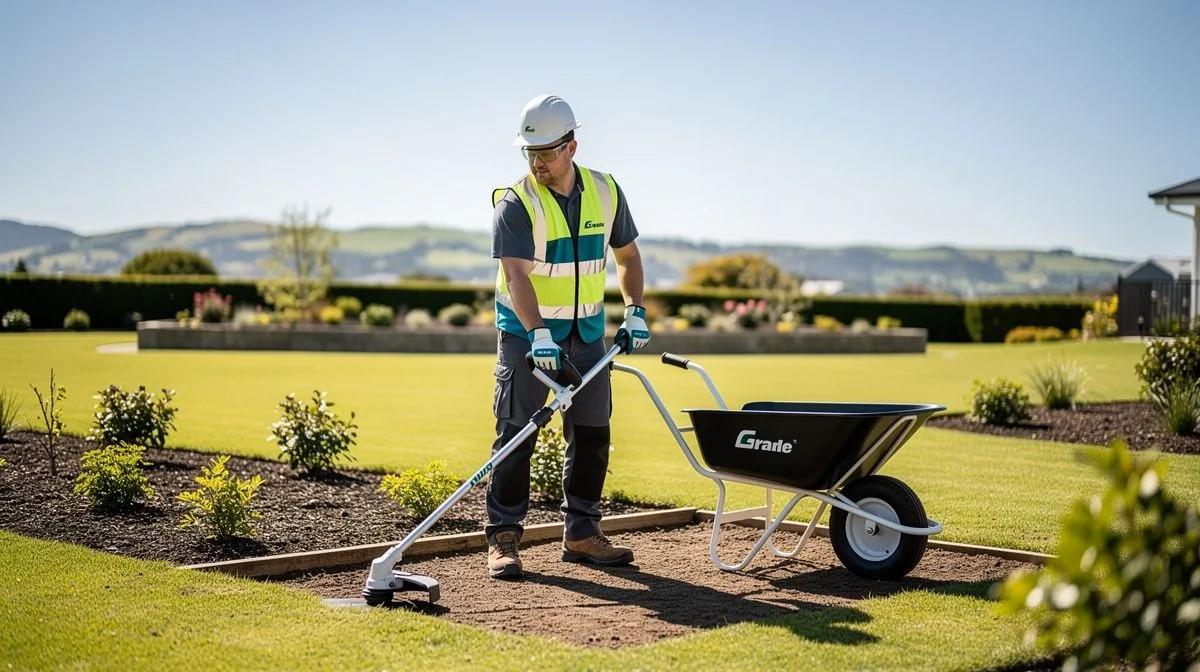
Access is the first thing a local landscaper looks at. If a digger cannot reach the back garden, everything moves by wheelbarrow, and that is labour at an hourly rate. On the hill suburbs, a narrow driveway or a right of way with steps changes the arithmetic before anyone has discussed a plant.
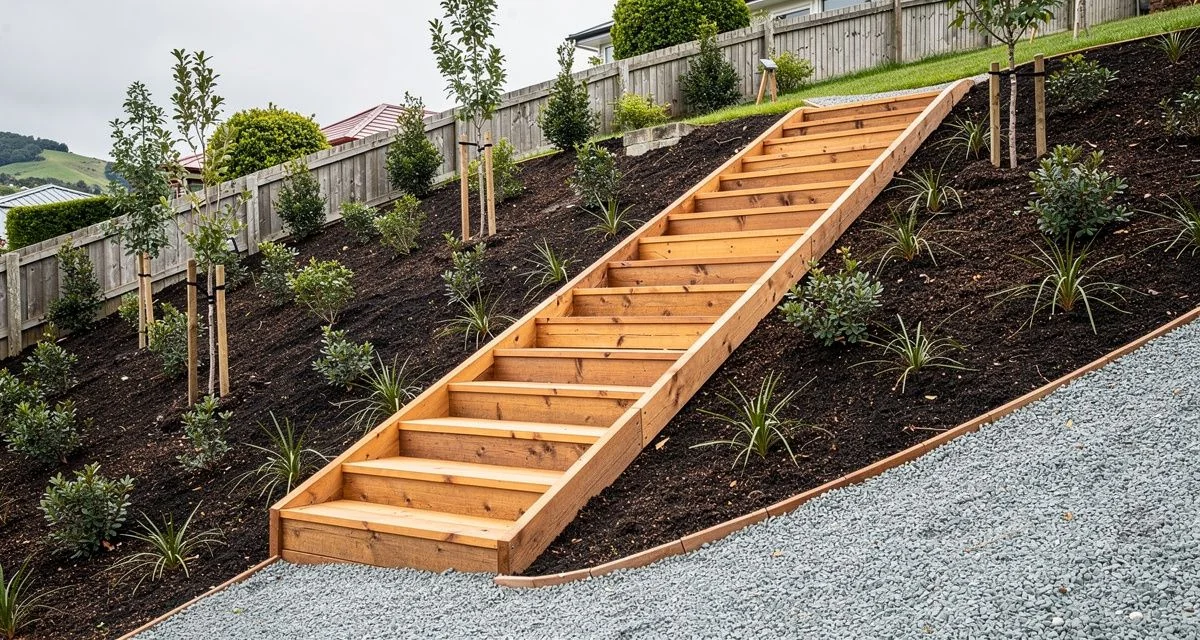
Slope is the second. A gentle fall needs shaping; a steep bank needs a retaining structure, and a wall over a certain height needs a design and a consent, which brings an engineer into the job. That is the single biggest jump in cost between two otherwise similar Dunedin sections.
Clay is the third. Water that sits on clay has to go somewhere, and a proper drainage layer, subsoil drain and clean-out cost money that nobody sees at the end. Skipping it is why so many new Dunedin gardens fail in their second winter.
How to Choose a Landscaper in Dunedin
Ask what the quote includes, line by line, and specifically whether it covers soil, drainage, waste removal and GST. The most common surprise on a landscaping invoice is the removal of spoil, which can be a significant sum on a site where the digger has been busy.
Ask about the retaining wall before you ask about anything else. Where a wall is over the threshold, you will need a consent and likely a designer or engineer: the official guidance on building work that needs consent sets out the rules, and your council handles the application. Any contractor who offers to skip it is telling you something useful about how they work.
Red flags worth writing down: a quote with one lump sum and no breakdown, no mention of waste or topsoil, a retaining wall with no detail about footings or drainage behind it, and a schedule that puts planting before earthworks.
Local Factors That Shape Dunedin Gardens
Steep sections and the cost of access
Large parts of Dunedin are built on slopes that would stop a project elsewhere. A practical answer is usually terraces with steps rather than one flat lawn, and that is labour-heavy. Where the garden is only reachable on foot, expect the crew rate to dominate the budget and plan the plant sizes around what can be carried in.
Clay, frost and a short growing season
Heavy clay holds winter water and dries hard later. The local fix is to break it up and add organic matter, then plant species that tolerate both extremes — many New Zealand natives do well here precisely because they evolved for it. Frost also means planting in spring rather than late autumn, so a scheme has a season to establish before winter arrives.
Wind, salt and protected trees
Exposed hill suburbs and the peninsula take wind and salt, and shelter planting is often the first thing worth doing because everything else grows better behind it. Older suburbs also have notable tree rules, and heavy pruning or removal can need council approval, so check before anyone arrives with a chainsaw.
Questions You Might Have
Do I need a designer for a normal-sized garden?
Not always. On a flat, easy section, a landscaper can usually work from your ideas. On a steep or awkward site, an hour or two of design advice pays for itself in avoided rework.
How long does a garden build take?
Small planting jobs can be a day or two. A full section with earthworks, retaining and paving is typically weeks, and wet weather adds days on top of that.
Can I do the planting myself to save money?
Yes, and it is a sensible split. Have the contractor finish the drainage, soil and structures, then plant it yourself over a weekend with their guidance.
What about irrigation?
Worth discussing on a new build where the soil is sandy, less so on heavy clay. If it is included, ask for the plan and the running cost.
What Matters Most
In Dunedin, the ground under the garden does more to decide the price than anything you plant in it. Drainage, retaining and access are the three things that separate a garden that improves year on year from one that needs rebuilding.
So interview the ground before you interview a plant. Get a line-by-line quote, sort consent before the digger arrives, and accept that on a steep section the first summer is mostly about structure. Everything after that is the enjoyable part.

The ValueHub Team built this site because finding clear, unbiased financial information in New Zealand was harder than it should be. Every guide is based on real research — we compare the actual fees, terms, and fine print so you don't have to. Our tip: shop around every year, read the policy docs, and never assume loyalty gets you the best deal.— The ValueHub Team
Try our Calculators
Use these free tools to crunch the numbers:
KiwiSaver Fund Comparison
Compare fees, returns, and risk levels across every KiwiSaver fund — the most up to date data in New Zealand.
Currency Converter — USD to NZD
Convert US Dollars to New Zealand Dollars instantly. See the latest exchange rate and 30-day trend.
Mortgage Repayment Calculator
Calculate your weekly, fortnightly, or monthly mortgage repayments. Free NZ mortgage calculator — try different rates, terms, and repayment frequencies.
Compound Interest Calculator
See how your savings grow with compound interest over time. Free NZ compound interest calculator with yearly, monthly, and weekly compounding options.
Term Deposit Calculator
Calculate your term deposit returns before you lock in. Compare interest earned across different terms and rates with ValueHub's free calculator.
Savings Goal Calculator
Calculate how long it will take to reach your savings goal — and what monthly deposit you need to get there. Free NZ savings planner.
Landscapers in Other Cities
Latest Guides & Reviews
Kōura KiwiSaver Scheme Review
Kōura KiwiSaver review: 13 open funds, fund charges from 0.63 to 1.10 per cent, and net returns to 30 June 2026.
reviewMaritime KiwiSaver Scheme Review
Maritime KiwiSaver review: 3 open funds, fund charges from 0.61 to 0.76 per cent, and net returns to 31 March 2026.
reviewMAS KiwiSaver Scheme Review
MAS KiwiSaver review: 7 open funds, fund charges from 0.25 to 0.98 per cent, and net returns to 30 June 2026.
reviewArotahi KiwiSaver Scheme Review
Arotahi KiwiSaver review: 1 open fund, a 0.77 per cent fund charge, and net returns to 31 March 2026. What the Government register shows you pay and get back.