Best Solar Panel Installers in Paraparaumu
Published 10 April 2025 · Updated 18 August 2026 · Written by the ValueHub team · Reviewed by Steve Baron
Best Solar Panel Installers in Paraparaumu
A coastal market where wind ratings and daytime use matter
Kāpiti households buy solar for a different mix of reasons than most of the country. Many are retired or work from home, which means someone is using power in the middle of the day, and that single fact improves the economics of solar more than any equipment choice.
The complication is the coast. Paraparaumu, Raumati and the beach settlements sit in a windy, salt-laden environment, and mounting systems have to be rated for the wind zone the property sits in. Wind-rated racking and extra fixings cost more than a standard installation, and a quote that ignores the exposure is not a complete quote.
Salt is the second coastal factor. It does not destroy panels, but it does affect the mounting hardware, the cable ducting and, over time, the exposed metal. Stainless or properly coated mounting is worth paying for on a property close to the sea.
The third factor is the housing mix. Kāpiti has a lot of single-storey homes on generous sections, which is generally good news for solar, and a growing number of new builds with roofs designed for it from the start.
Our Trusted Solar Panel Installers
We feature businesses that demonstrate strong performance, proven experience, and consistently positive customer feedback. Some of the providers listed may have commercial relationships with us, but all are selected based on quality and reliability.
To begin, reach out to them and speak with them directly — this helps you explain your job, ask questions, and confirm whether they're the right fit.
The experts in Plumbing & Electrical. When you hire a Laser Plumber or Electrician, you'll receive our 'Totally Dependable' service! Timely delivery, a promise of care and skill; appropriate work for customers' needs; well-presented, professional employees; responsibility for supplied materials, honouring manufacturer guarantees; and meeting and frequently exceeding our customers' expectations.
How We Researched This Guide
We worked from published New Zealand solar cost data, including the component breakdown of a typical installation, because that is what tells you whether a quote is priced fairly rather than simply what the total is.
The number that stood out is that the panels themselves are only about 35 per cent of an installed system. The inverter, mounting, wiring, labour and compliance make up the other two thirds, and coastal wind-rated mounting sits at the top of that range. We also read up on the consumer rules that apply to a large purchase, explained by Consumer Protection.
The 60-Second Version
The short version, before the detail.
- A 5 kW system is about $11,000–$13,000 installed, and a 6.6 kW system $12,500–$16,500.
- Panels are roughly 35 per cent of the total cost; labour is about 22 per cent.
- Coastal exposure can push mounting and fixings to the top of their range.
- Exports earn about 7–16 cents a unit against 28–36 cents for power used at home.
- Batteries add $9,000–$15,000 and take many years to pay back.
- There is no government subsidy in New Zealand.
Where the Money Goes
Published New Zealand cost breakdown for a typical 6.6 kW installation.
| Component | Cost | Share of total |
|---|---|---|
| Panels, 16 units | $4,500–$6,500 | 35% |
| Inverter | $1,800–$3,500 | 18% |
| Mounting and racking | $800–$1,500 | 8% |
| Wiring, isolators and switchboard work | $700–$1,500 | 7% |
| Labour, electrician and roofer | $2,500–$4,500 | 22% |
| Compliance, certification and network application | $400–$800 | 4% |
| Installer margin and overheads | $600–$1,500 | 6% |
| Total installed | $12,500–$16,500 | 100% |
Cost breakdown verified from published New Zealand solar industry price data as of September 2026. Figures include GST, and coastal or complex installations sit at the upper end of the labour and mounting ranges.
Coastal Exposure and Wind Zones
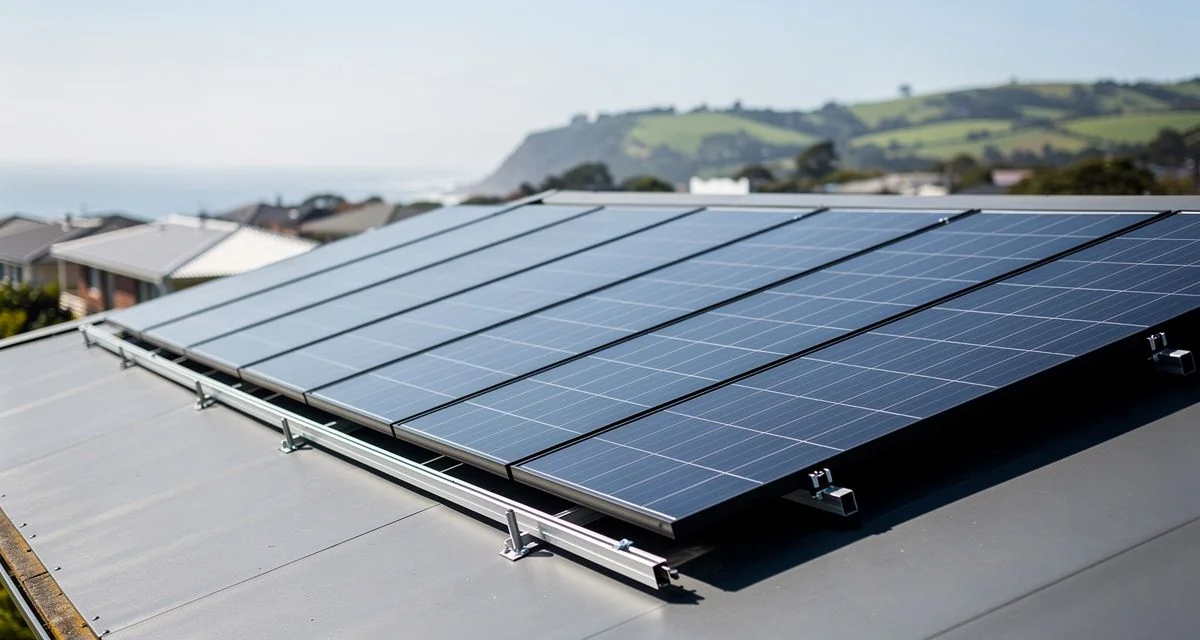
New Zealand buildings are classified by wind zone, and the Kāpiti coast includes some of the more exposed classifications, particularly on the seaward side of the main road and in the beach settlements. Racking systems are rated for these zones, and an array that is specified for a lower zone is a risk rather than a saving.
The practical difference is more fixings, heavier rails and sometimes a different mounting method. It adds cost to a part of the job that is already 8 per cent of the total, so the effect is measurable but not enormous. What matters is that the quote states the wind zone the system has been specified for.
Salt spray is the other half of the coastal problem. Panels are laminated glass and are largely unaffected, but brackets, bolts, cable trays and the inverter enclosure are not. Ask what the mounting hardware is made of and how it is protected, and expect a shorter inspection cycle for a property a few hundred metres from the beach.
Why Daytime Use Changes the Numbers
Solar is worth more when you use it yourself. Power consumed in the house offsets retail electricity at roughly 28 to 36 cents a unit, while power exported to the grid earns a buyback rate of about 7 to 16 cents depending on the retailer and plan.
In a suburb where a lot of households have someone home during the day, that gap is easier to exploit. Hot water cylinders on a timer, washing and drying during the day, and charging an electric vehicle in the afternoon all shift consumption into the hours the panels are producing.
For a household that is out from morning until evening, the same system produces the same power and saves noticeably less, because most of it is exported at the lower rate. That is the calculation worth doing before choosing a system size, and it explains why two similar Kāpiti houses can justify quite different arrays.
System Size, Buyback and Payback
The six to seven kilowatt system has become the standard residential size for a reason. It roughly matches what a household can consume during the day, which means most of the generation is used at retail value rather than exported.
Going bigger than that only makes sense where there is a large daytime load, such as a heat pump running all day, a pool, or an electric vehicle charged at home. Otherwise the extra panels earn the export rate, and the additional cost takes much longer to recover.
Payback on a system without a battery sits around six to eight years nationally. In a household that uses its generation well, it sits at the shorter end; where most power is exported, it stretches out.
Batteries change the arithmetic again. They shift evening consumption onto stored solar, which is worth the full retail rate rather than the export rate, but at $9,000 to $15,000 for a 10 to 13 kWh unit the payback is measured in many years. They suit households with heavy evening use or a poor buyback offer, and they are not automatically the right call.
Choosing an Installer in Paraparaumu
Ask what wind zone the property is in and how the mounting has been specified for it. A quote that does not mention exposure on a coastal property has either assessed it and not said so, or has not considered it.
Ask what annual generation is expected, in writing, and on what basis. An installer who can explain the roof orientation, the pitch and the shading is working from a site assessment rather than a formula.
Ask who does the electrical work and who handles the network application. Installation involves a licensed electrician and an application to the lines company for the export connection, and both should be in the quote rather than left to you.
Ask about the warranties on the inverter and the mounting hardware as well as the panels. The inverter is the component most likely to need replacing within the life of the system, and coastal hardware is the component most likely to corrode.
Get at least two quotes for the same specification, then compare price per watt. Under New Zealand consumer law a system has to be of acceptable quality and fit for purpose, and Consumer Protection explains what you can do if it is not. The Commerce Commission covers the rules on contract terms.
Local Factors Worth Knowing
Exposure and the seaward side
Properties on the seaward side of the coastal settlements face the strongest combination of wind and salt. Budget for stainless fixings and expect the mounting to be assessed more carefully than on an inland property.
Retired households and daytime consumption
Kāpiti has a high proportion of retired residents, which is genuinely favourable for solar because the house is occupied during the day. A smaller system used well often beats a larger one that exports most of its output.
New builds and rooftops designed for panels
New subdivisions in the district increasingly have roofs laid out with solar in mind. If you are building, raising the roof pitch and orientating the ridge north costs very little at consent stage and saves awkward compromises later.
Questions You Might Have
Does salt damage solar panels?
Not the glass panels themselves. It does affect mounting hardware, bolts and exposed metal, which is why coastal installations should use appropriately protected fixings.
Will I need resource consent?
Rooftop panels on a residential property normally do not need consent, though rules differ for heritage areas and some coastal locations. Ask the installer, and check with the district council if the property has a designation.
How much power will a 6.6 kW system make?
It depends on orientation, pitch and shading, which is why the figure should come from a site assessment rather than a rule of thumb. Ask for it in writing as an annual total.
Is a battery worth it?
Sometimes. It makes most sense with heavy evening use or a poor buyback rate, and least sense as a default addition to every quote.
What Matters Most
Kāpiti is a reasonable place for solar, with decent daylight and plenty of households that are home during the day to use what the roof produces. The variables that decide the return are the roof, the exposure and the size, not the brand on the panel.
The sensible approach is to get a proper site assessment that accounts for the wind zone and salt, ask for expected generation in writing, and size the system around daytime consumption rather than the largest array the roof will hold.

The ValueHub Team built this site because finding clear, unbiased financial information in New Zealand was harder than it should be. Every guide is based on real research — we compare the actual fees, terms, and fine print so you don't have to. Our tip: shop around every year, read the policy docs, and never assume loyalty gets you the best deal.— The ValueHub Team
Try our Calculators
Use these free tools to crunch the numbers:
KiwiSaver Fund Comparison
Compare fees, returns, and risk levels across every KiwiSaver fund — the most up to date data in New Zealand.
Currency Converter — USD to NZD
Convert US Dollars to New Zealand Dollars instantly. See the latest exchange rate and 30-day trend.
Mortgage Repayment Calculator
Calculate your weekly, fortnightly, or monthly mortgage repayments. Free NZ mortgage calculator — try different rates, terms, and repayment frequencies.
Compound Interest Calculator
See how your savings grow with compound interest over time. Free NZ compound interest calculator with yearly, monthly, and weekly compounding options.
Term Deposit Calculator
Calculate your term deposit returns before you lock in. Compare interest earned across different terms and rates with ValueHub's free calculator.
Savings Goal Calculator
Calculate how long it will take to reach your savings goal — and what monthly deposit you need to get there. Free NZ savings planner.
Solar Panel Installers in Other Cities
Latest Guides & Reviews
KiwiSaver and Tax — PIR, ESCT and What You Actually Pay
KiwiSaver is taxed twice — ESCT on your employer's contribution and your PIR on the fund's returns. How each rate is set, and the two most members never check.
reviewInvestNow KiwiSaver Scheme Review
InvestNow KiwiSaver review: 45 open funds, fund charges from 0.03 to 1.38 per cent, and net returns to 30 June 2026.
reviewKernel KiwiSaver Scheme Review
Kernel KiwiSaver review: 25 open funds, fund charges from 0.25 to 0.45 per cent, and net returns to 30 June 2026.
guideTax Debt in New Zealand — The Numbers
Official figures on New Zealand's overdue tax debt: the total, the collectable share, which customer groups hold it, and how much is repaid or written off.