Best Solar Panel Installers in Wellington
Published 11 September 2026 · Written by the ValueHub team · Reviewed by Steve Baron

In Wellington, Wind Comes Before Sunlight
Every solar conversation in Wellington eventually turns to the same question: will the array still be on the roof in a northerly? The city's wind is not a minor design detail. It determines the mounting system, the spacing of the fixings, and how much of your quote is spent holding the panels down rather than generating power.
That does not make solar a bad idea here. Wellington gets strong sunlight through summer, and retail power prices are high enough that self-consumed generation is worth real money. It does mean you have to read the quote carefully, because the cheapest option is often the one least suited to a ridgeline section.
The other local factor is the decision itself. A solar array is a long-lived improvement, so it is best judged over the years you will actually live with it rather than on a shorter view. Get the specification right, and the system keeps earning for decades.
How We Researched This Guide
We started with the engineering, because mounting standards are what separate a Wellington quote from a quote written for somewhere calmer. We looked at how exposure zones affect fixings, rail spacing and framing, then priced that against published installer guides for the region.
We also worked through the consumer protections covering installation work. Where installers or sources disagree, we give the range rather than a single figure, and we have kept every number to those we could verify.
Our Trusted Solar Panel Installers
We feature businesses that demonstrate strong performance, proven experience, and consistently positive customer feedback. Some of the providers listed may have commercial relationships with us, but all are selected based on quality and reliability.
To begin, reach out to them and speak with them directly — this helps you explain your job, ask questions, and confirm whether they're the right fit.
ZEN Energy delivers reliable solar energy systems for homes and businesses, using premium solar panels to reduce energy costs across New Zealand. Madeleine’s solar story will resonate with thousands of Kiwi homeowners: rising power costs, the search for trustworthy advice, and a transition to an energy solution that gives control back to the homeowner.
The 60-Second Version
If you read only one section, read this.
- A fair installed price is $1.70–$2.00 per watt including GST, but wind-rated mounting pushes Wellington quotes toward the top of that range.
- A 6.6 kW system usually costs $13,000–$15,000 before any premium for exposure or access.
- New Zealand has no solar subsidy or rebate. There is nothing to apply for and nothing to subtract.
- Payback is typically six to eight years without a battery.
- A battery adds $9,000–$15,000 for 10–13 kWh usable and rarely shortens that payback.
- Self-consumption is where the savings sit. Exporting at a low buy-back rate is not the win.
What Solar Costs in Wellington
Base pricing is national, but two Wellington realities move it upward: exposure-rated mounting and difficult access on steep sites. Treat the bands below as the starting point, then expect extra for scaffolding, long cable runs or a switchboard that needs replacing.
| System size | Typical installed cost |
|---|---|
| 3 kW | $8,000–$10,000 |
| 5 kW | $11,000–$13,000 |
| 6.6 kW | $13,000–$15,000 |
| 8–10 kW | $15,000–$18,000 |
| 13 kW and above | $20,000–$30,000 |
| Battery, 10–13 kWh usable | $9,000–$15,000 |
Installed prices including GST, based on published New Zealand installer pricing guides. Exposure-rated mounting, scaffolding and switchboard work are additional.
Price per watt drops as the system grows. A 3–4 kW system averages around $2.31 per watt, while a 13–14 kW system averages around $1.42 per watt. The median system installed in New Zealand homes is around 7–8 kW, and that remains a reasonable target unless your daytime use is unusually heavy.
Why Wind-Rated Mounting Changes the Quote
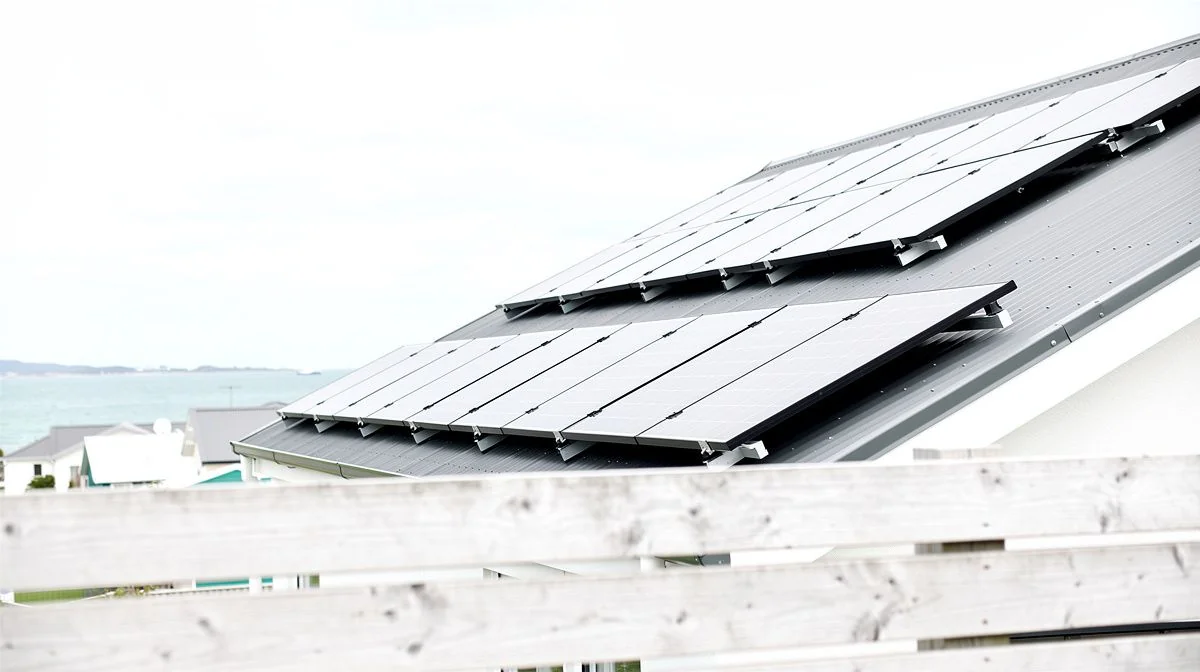
A panel is a sail. In an exposed location, it has to be fixed so that uplift, not just weight, is resisted. That means heavier rails, more frequent fixing points, and a mounting system rated for the wind zone the property sits in. Costs are higher wherever wind-rated mounting is required, and in Wellington that is most of the time.
This is the part of the quote worth scrutinising hardest. Ask what wind zone the property falls into, what the mounting is rated for, and whether the fixings are specified for your roof type. A quote that does not mention exposure at all is either priced for somewhere else or has skipped a step.
The bigger system is not automatically the safer purchase here either. A larger array on an exposed roof carries more uplift load, so the mounting specification matters more, not less, as the panel count rises.
Self-Consumption in a Commuter City
Wellington households tend to be out of the house during the working day, which is exactly when panels generate. That is the central tension in the local numbers. Every unit you use yourself offsets a retail rate of roughly $0.28–$0.36 per kWh, among the highest in the OECD outside Europe, while exported units earn a fraction of that.
So the useful question is what runs in your house between morning and evening. A heat pump left on, a hot water cylinder, a home office or an electric vehicle all shift the maths in your favour. If nothing does, be realistic that a large array will spend much of its output being sold cheaply.
No Subsidy, and Payback as a Long Game
New Zealand offers no government rebate or subsidy for residential solar. Nothing is discounted at the point of sale, le and there is no scheme to wait for. Australian households receive support that New Zealand households do not, which is why quotes here look higher than figures you may have seen across the Tasman.
The other thing to weigh is income certainty. Public-sector restructuring has made some professional incomes here less predictable than they were, which argues for keeping a cash buffer rather than committing the maximum to a long-lived improvement.
Neither point rules solar out, but together they argue for buying the right size system rather than the largest one, and for treating payback as a long game rather than a quick return.
Wellington Factors That Change the Numbers
Steep Sites and Difficult Access
Much of the city is built on hills, and a steep section adds cost before a single panel is fitted. Scaffolding, hoisting and safe access all take time, and narrow driveways can rule out the usual equipment. Ask for access costs to be itemised rather than bundled into one figure.
Salt Spray and Coastal Corrosion
Coastal suburbs face salt-laden air that corrodes mounting hardware and exposed fittings faster than inland conditions do. Specifying coated or marine-grade components costs a little more upfront and is the difference between a system that lasts twenty years and one that needs rework well before that.
Seismic Risk and Older Buildings
Wellington carries the country's highest earthquake exposure, and many homes are older timber or brick buildings. Roof framing on an older house may need strengthening before it can carry an array. A competent installer will check the structure rather than assume it.
Incomes Tied to the Public Sector
Government agencies support a large share of professional employment here, and rounds of restructuring have made some of those roles less predictable. If your household income leans on one dominant employer, a smaller system and a retained cash buffer is often the more sensible combination.
Choosing an Installer in Wellington
Prioritise exposure experience over the lowest headline price. Ask how many arrays the firm has installed in your wind zone and on your roof type, and ask to see a specification rather than a description. Local knowledge of Wellington's conditions is worth paying something for.
Get three written quotes for the same system size and mounting specification, then compare the components. Inverters, rails and workmanship warranties vary widely, and a quote that is much cheaper than the others is usually cheaper for a reason you will discover later.
Warning Signs
- A quote that never mentions wind zone, exposure or mounting ratings.
- Any claim that a government solar subsidy or rebate is available.
- Savings figures based on total generation rather than power used on site.
- No site visit, or a roof assessment carried out from the street.
- Unwillingness to put the mounting specification in writing.
- A workmanship warranty that is verbal or shorter than the product warranties.
Questions Wellington Homeowners Ask
Can you even install solar on an exposed Wellington roof?
Yes. The requirement is a mounting system engineered for the wind zone, not a different kind of panel. The practical effect is cost, not feasibility, and the extra spend goes into rails and fixings rather than generation.
Is solar worth it here without a subsidy?
For an owner-occupier with a decent roof and daytime load, payback typically runs six to eight years, and the system should last more than twenty. On a heavily shaded section, or a house that is empty every weekday, the case weakens considerably.
Should I buy a battery with the panels?
Rarely on the numbers alone. A battery adds $9,000–$15,000 for 10–13 kWh of usable capacity and mainly shifts your own generation into the evening. It raises self-consumption but seldom shortens payback, so treat it as a separate decision rather than part of the panel purchase.
Do I need to fix my roof first?
Often, yes. On older Wellington homes, the roof may be near the end of its life, and lifting an array to re-roof underneath is far more expensive than re-roofing first. Have the roof assessed before you sign anything.
What Matters Most
The Wellington decision comes down to two things: a mounting system built for the wind, and a system size matched to the power you actually use on site. Get those right and solar works well here. Get them wrong, and you have paid a premium for a system that exports most of its output.
Ignore any mention of a subsidy, because there is none, and be sceptical of payback figures that assume every kilowatt-hour is consumed at retail rates. To see how these numbers compare around the country, start with our solar panel installers hub.

The ValueHub Team built this site because finding clear, unbiased financial information in New Zealand was harder than it should be. Every guide is based on real research — we compare the actual fees, terms, and fine print so you don't have to. Our tip: shop around every year, read the policy docs, and never assume loyalty gets you the best deal.— The ValueHub Team
Try our Calculators
Use these free tools to crunch the numbers:
KiwiSaver Fund Comparison
Compare fees, returns, and risk levels across every KiwiSaver fund — the most up to date data in New Zealand.
Currency Converter — USD to NZD
Convert US Dollars to New Zealand Dollars instantly. See the latest exchange rate and 30-day trend.
Mortgage Repayment Calculator
Calculate your weekly, fortnightly, or monthly mortgage repayments. Free NZ mortgage calculator — try different rates, terms, and repayment frequencies.
Compound Interest Calculator
See how your savings grow with compound interest over time. Free NZ compound interest calculator with yearly, monthly, and weekly compounding options.
Term Deposit Calculator
Calculate your term deposit returns before you lock in. Compare interest earned across different terms and rates with ValueHub's free calculator.
Savings Goal Calculator
Calculate how long it will take to reach your savings goal — and what monthly deposit you need to get there. Free NZ savings planner.
Solar Panel Installers in Other Cities
Latest Guides & Reviews
SuperLife KiwiSaver Scheme Review
SuperLife KiwiSaver review: 65 open funds, fund charges from 0.20 to 1.30 per cent, and net returns to 30 June 2026.
reviewSuperEasy KiwiSaver Scheme Review
SuperEasy KiwiSaver review: 8 open funds, a 0.32 per cent fund charge, and net returns to 31 March 2026.
reviewWestpac KiwiSaver Scheme Review
Westpac KiwiSaver review: 8 open funds, fund charges from 0.25 to 0.70 per cent, and net returns to 30 June 2026.
reviewANZ KiwiSaver Scheme Review
Review of ANZ KiwiSaver. Three schemes, fees from 0.22 per cent, the closed Default scheme, OneAnswer and the Lifetimes option.