Indoor Gardening Equipment Guide: Getting Started in New Zealand
Published 07 August 2026 · Updated 01 September 2026
Indoor Gardening Equipment Guide: Getting Started in New Zealand
Indoor growing has moved well past the windowsill. The kit is better, the lights are cheaper to run, and a shelf in a spare room can now produce herbs and greens right through a Southland winter. The single most surprising thing about the whole hobby is how little of your money goes on the equipment and how much goes on the light's electricity bill.
That is the part most starter guides skate over. A grow light is the one item in the setup that runs for many hours every single day, which makes it the dominant ongoing cost and the reason indoor growing pairs unusually well with off-peak power plans.
We have kept this guide to the equipment itself: what each piece does, how to size a light without getting caught out, and how to work out what your own setup will cost to run using your own power rate rather than somebody else's average.
How We Researched This Guide
The running-cost method here comes from EECA, the Energy Efficiency and Conservation Authority. Its guidance is to find an appliance's annual energy consumption in kWh on its Energy Rating Label and multiply by your tariff. EECA's own worked example — 180 kWh a year at 30c per kWh — comes to about $54 annually. That formula is the backbone of the cost section below.
Two things stood out. First, EECA's guidance is explicit that you should use your own rate from your own bill, and that the rate you pick changes the answer materially — so we give you the formula and let you substitute. Second, Energy Rating Labels are mandatory on regulated products under the Energy Efficiency (Energy Using Products) Regulations 2002, and high performance monitors are not regulated at all. That matters when you are comparing a light against a fan against a dehumidifier.
The Quick Summary (60-Second Version)
If you only read one part of this guide, read this.
- Light is the binding constraint on indoor growing — a bright windowsill rarely delivers enough consistent light, especially through shorter winter days.
- Full-spectrum LED is the current standard. Older HID and HPS lamps run hotter and draw more power for the same light output.
- Compare lamps on actual wall draw, not advertised or "equivalent" wattage — a 400W HPS is not the same as a 400W LED.
- A plug-in timer is essential, not optional. Most plants want a consistent 12 to 16 hour daily cycle.
- Ventilation and a small circulation fan are what stop mould in a sealed tent.
- Run the numbers on your own power rate: monthly light cost = (actual watts ÷ 1000) × hours per day × 30 × your $/kWh.
What You Actually Need, and What You Do Not
The light is the whole game
Everything else in an indoor setup supports the light. Full-spectrum LED units cover blue through to far-red, so one fixture can carry plants from seedling through to flowering and fruiting. They run cooler than the older high-intensity discharge and high-pressure sodium lamps, which is not a small thing in a sealed tent where the lamp is the heat source.
The trap is wattage. Advertised or "equivalent" wattage is not the same as actual power draw, and a 400W HPS is not equivalent to a 400W LED. Look for the figure the unit draws from the wall, because that number drives both your electricity cost and whether a household circuit can carry the load.
Sizing without guessing
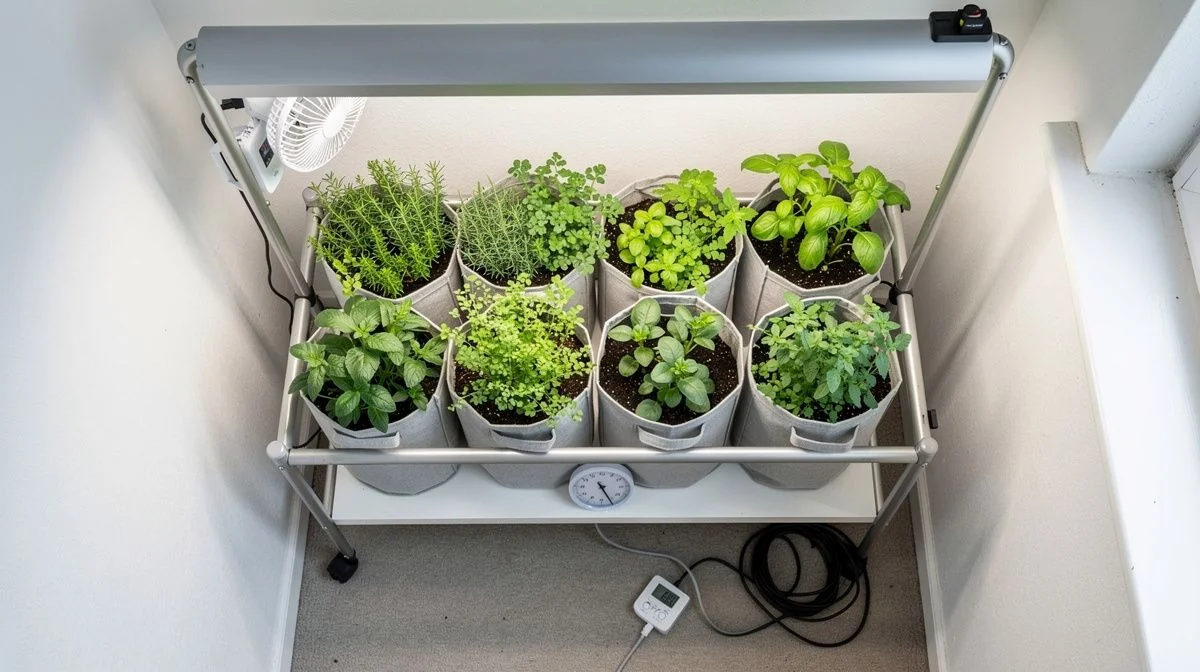
For herbs and leafy greens on a shelf, a 100-watt LED panel is usually sufficient. Larger tents growing fruiting plants need roughly 300 to 700 watts depending on the growing area. Those are the only sizing figures we would hang anything on — treat them as a starting range and match them to your actual footprint and ceiling height.
Someone running several high-wattage lights should have the circuit checked rather than daisy-chaining multi-boards. Watering systems and electricity share a small space, so keep cables clear of reservoirs and drips.
The supporting cast
Air movement and filtration matter in an enclosed space. Stale, humid air invites mould and slows growth, so a fan — and in a tent, a filter — is part of the basic kit rather than an upgrade. A small circulation fan strengthens stems and evens out temperature and humidity across the canopy.
A combined thermometer and hygrometer lets you see conditions instead of guessing. Fabric grow bags, saucers and pots, plus a potting mix or hydroponic medium, make up the rest. A pH meter becomes necessary once you start mixing nutrients, because uptake depends on pH.
| Setup | Typical light draw | Runs longest hours? | Main ongoing cost |
|---|---|---|---|
| Herb shelf | Around 100W LED | Yes — the light | Electricity, then seeds and medium |
| Small tent, leafy greens | Mid-range LED | Yes — the light | Electricity, plus filters and wicks |
| Tent, fruiting plants | Roughly 300–700W LED | Yes — the light | Electricity, then nutrients |
| Hydroponic kit | Depends on site count | Yes — the light | Electricity, plus pumps and nutrients |
What It Costs to Run, and How to Work It Out
Purchase cost is driven by light wattage and quality, tent or growing-area size, whether filtration is included, and how much automation you want. A shelf-and-light setup and a full tent system with filtration are not comparable purchases, which is exactly why quoted "starter kit" prices vary so wildly.
Ongoing cost is dominated by the light, because it runs the longest hours of anything in the setup. Seeds, growing medium and nutrients are modest by comparison, and pumps, filters and wicks add small periodic replacement costs.
Here is the formula, straight from EECA's method: monthly light cost = (actual watts ÷ 1000) × hours per day × 30 × your rate per kWh. Work one through. A 200-watt light running 16 hours a day draws 3.2 kWh daily. At a rate of 30c per kWh — a figure EECA suggests as a national average if you do not have a bill handy — that is roughly 96c a day, or about $29 a month. At 20c it is closer to $19. At 40c it is nearer $38.
That spread is the point. Use your own rate. And because grow lights run many hours a day, they suit time-of-use and off-peak plans unusually well — shifting the light cycle into cheaper hours is one of the few genuine ways to cut the running cost.
Questions You Might Have
Do I really need a grow light, or will a sunny window do?
For seedlings and the hardiest herbs, a good window can work for part of the year. For anything you want to harvest steadily, no. Even a bright windowsill rarely provides enough consistent light, particularly through New Zealand's shorter winter days. A dedicated light is the single most important piece of equipment you will buy.
Should I buy a starter kit or assemble the pieces myself?
Kits save you the compatibility guesswork, but the light inside is often the weakest part. If you assemble your own, spend the money on the light and go cheaper on the tent. A modest enclosure with a good LED will outperform a fancy tent with an underpowered lamp every time.
Can I run this in a rental or an apartment?
Yes, and it is one of the main reasons people start. A compact tent or shelf setup takes very little floor space, and there is no digging, no landlord permission needed and no weather to work around. Just make sure you have a power point nearby and somewhere for the warm exhaust air to go.
What should I grow first?
Herbs and leafy greens. Lettuce, spinach, kale, basil, coriander, mint and parsley all grow well under LED light with minimal fuss, and they are forgiving while you learn how your space behaves. Fruiting plants like chillies and cherry tomatoes need more light intensity and a longer cycle, so save them for round two.
How do I know if my light is costing too much?
Do the formula above with your real rate and your light's real wall draw, then compare that monthly figure against what the same money buys in fresh produce. If the number looks wrong, the usual culprits are a higher-wattage light than your space needs, or hours on the timer set longer than the plants require.
What Matters Most
Indoor gardening rewards people who buy the light properly and stay relaxed about everything else. The tent, the pots, the fan and the timer all matter, but they are supporting players. Get the light right — full-spectrum, sized to your actual growing area, and judged on wall draw rather than marketing wattage — and the rest of the setup becomes a series of small, cheap decisions.
The cost question is the one most guides get wrong. There is no single monthly figure that applies to you, because your power rate is the variable that decides it. Run the formula with your own rate before you buy anything, and you will know within a few dollars what the hobby actually costs you.
And if your light is going to run 16 hours a day anyway, it is worth checking whether an off-peak or time-of-use plan suits your household. That one change can quietly do more for your running costs than any piece of equipment you buy.

The ValueHub Team built this site because finding clear, unbiased financial information in New Zealand was harder than it should be. Every guide is based on real research — we compare the actual fees, terms, and fine print so you don't have to. Our tip: shop around every year, read the policy docs, and never assume loyalty gets you the best deal.— The ValueHub Team
Try our Calculators
Use these free tools to crunch the numbers:
KiwiSaver Fund Comparison
Compare fees, returns, and risk levels across every KiwiSaver fund from all 31 NZ providers.
Currency Converter — USD to NZD
Convert US Dollars to New Zealand Dollars instantly. See the latest exchange rate and 30-day trend.
Mortgage Repayment Calculator
Calculate your weekly, fortnightly, or monthly mortgage repayments. Free NZ mortgage calculator — try different rates, terms, and repayment frequencies.
Compound Interest Calculator
See how your savings grow with compound interest over time. Free NZ compound interest calculator with yearly, monthly, and weekly compounding options.
Term Deposit Calculator
Calculate your term deposit returns before you lock in. Compare interest earned across different terms and rates with ValueHub's free calculator.
Savings Goal Calculator
Calculate how long it will take to reach your savings goal — and what monthly deposit you need to get there. Free NZ savings planner.
Related Articles
Solar Power For Homes: A Complete Guide to Solar Panels in New Zealand
What solar panels cost in NZ, how to verify an installer's credentials, the bank green loans worth knowing about, and what a realistic payback period actually looks like.
reviewBest EVs in NZ: Costs, Charging & Buying Guide
Compare the best EV cars in NZ for 2026 — prices, real-world range, charging costs, RUC, and which models suit Kiwi roads. Updated monthly.